Football decisions3 min read
A still image of an attacker ahead of a defender can start an argument without answering the whole offside question. Build a two-question observation card: where was the player at the relevant moment, and how did that player become involved? The separation makes a replay easier to describe without pretending to officiate it.
Read the guide ↗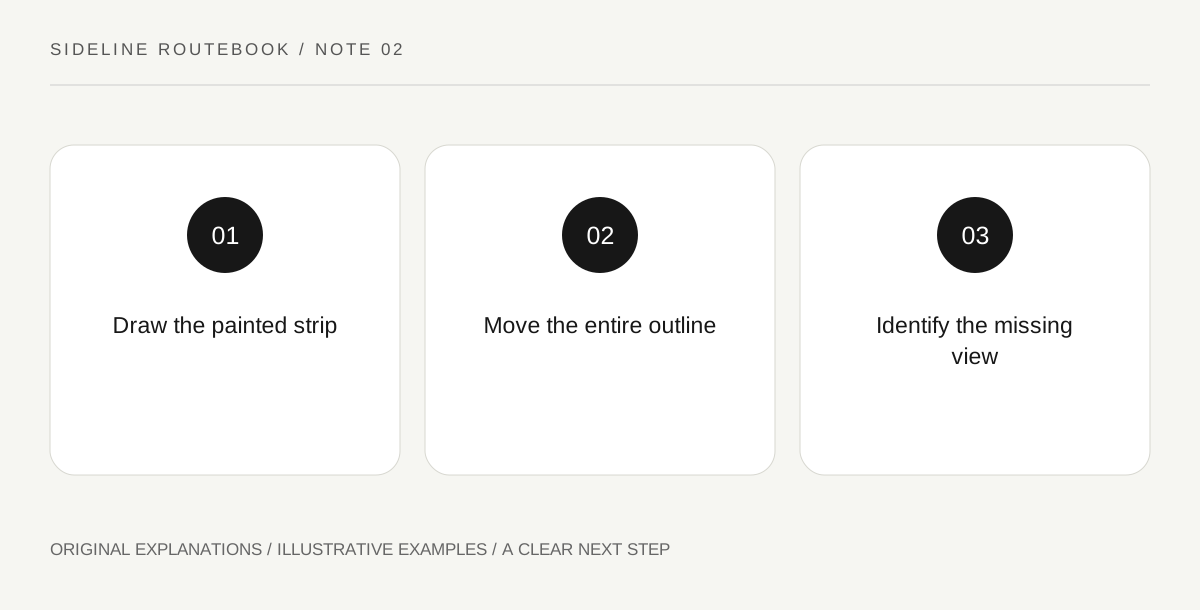
Football decisions3 min read
A ball’s contact with the grass is a small part of its shape. To understand a boundary replay, sketch the entire ball relative to the line rather than watching only its bottom. This paper exercise explores the whole-ball principle without claiming that a television still can supply an accurate official measurement.
Read the guide ↗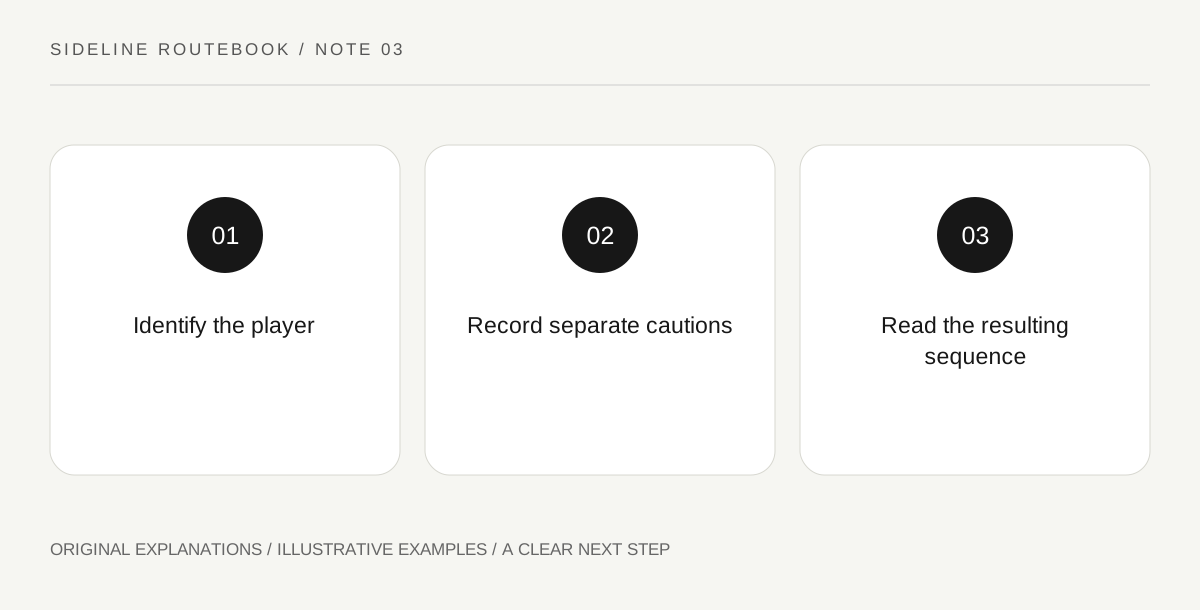
Football decisions3 min read
A red card shown after a yellow can describe a different disciplinary sequence from a direct red. A small player-specific timeline helps you follow which caution belongs to whom and when. The aim is to read the displayed sequence accurately before forming an opinion about the underlying incidents.
Read the guide ↗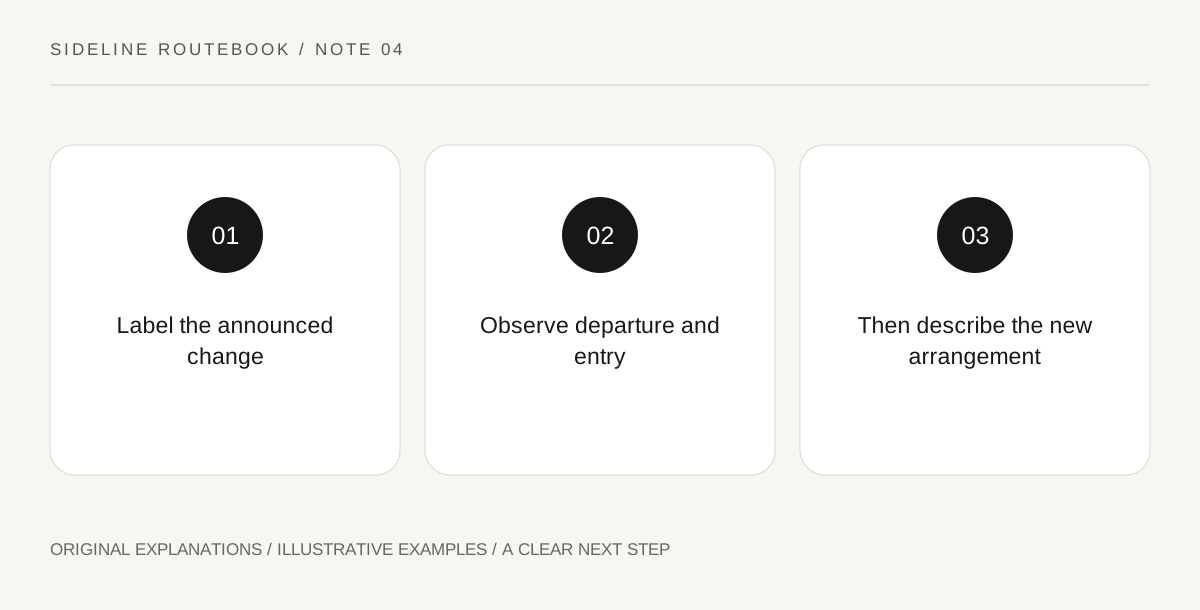
Football decisions3 min read
A substitution board tells viewers that a change is being organized. It does not by itself show every stage of the procedure. Make a three-stage observation strip for announcement, departure and entry, then use it to follow one change without confusing a television caption with the player’s actual arrival.
Read the guide ↗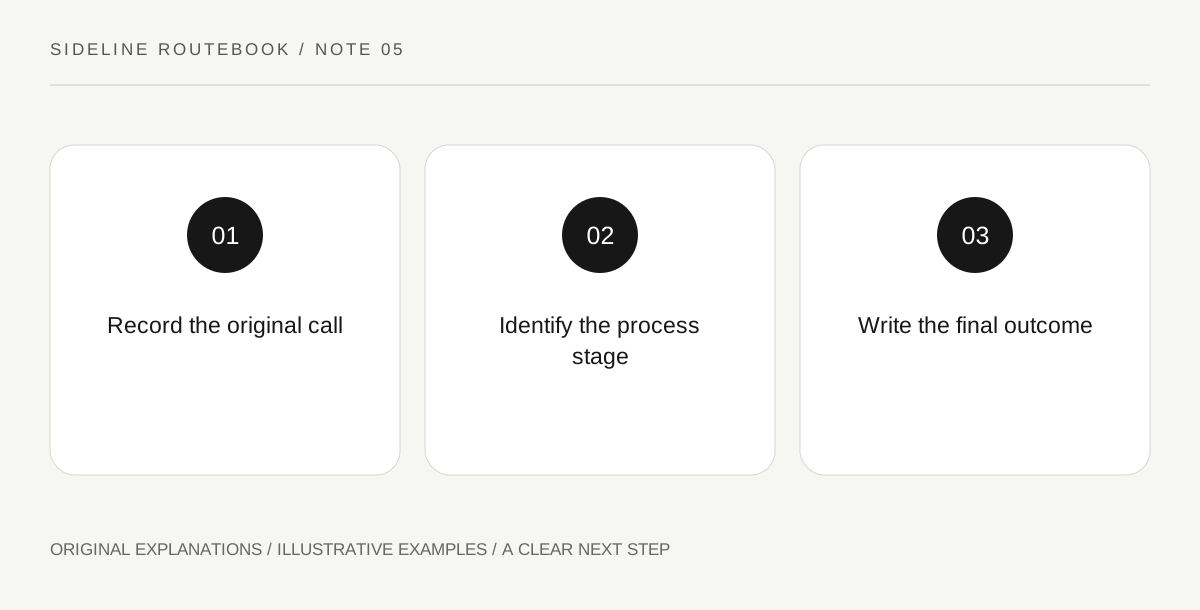
Football decisions3 min read
A pause and a replay montage can make every VAR situation look identical. A three-line record helps you follow the process: information being checked, a review if initiated and the referee’s final decision. It also keeps a television commentator’s prediction from quietly becoming your record of what the officials actually decided.
Read the guide ↗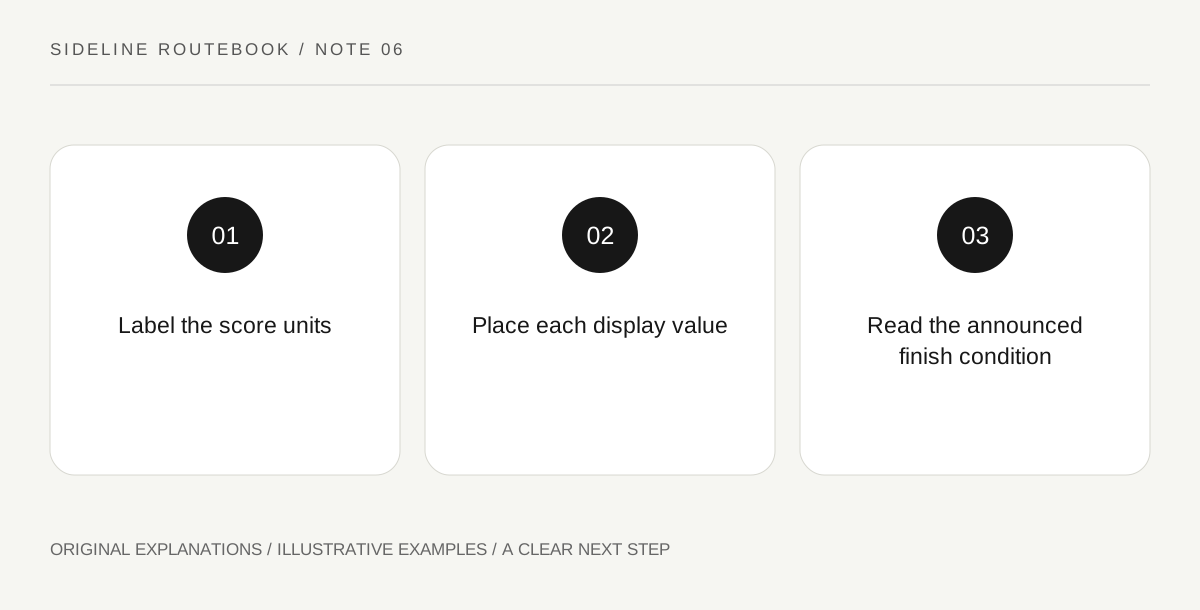
Racket and court scores3 min read
A tennis display may show sets, games and the current point score beside the same two names. Read those numbers as different units rather than one large arithmetic total. A small nested score ladder helps you locate the part of the match that a commentator is discussing and avoid adding unrelated columns together.
Read the guide ↗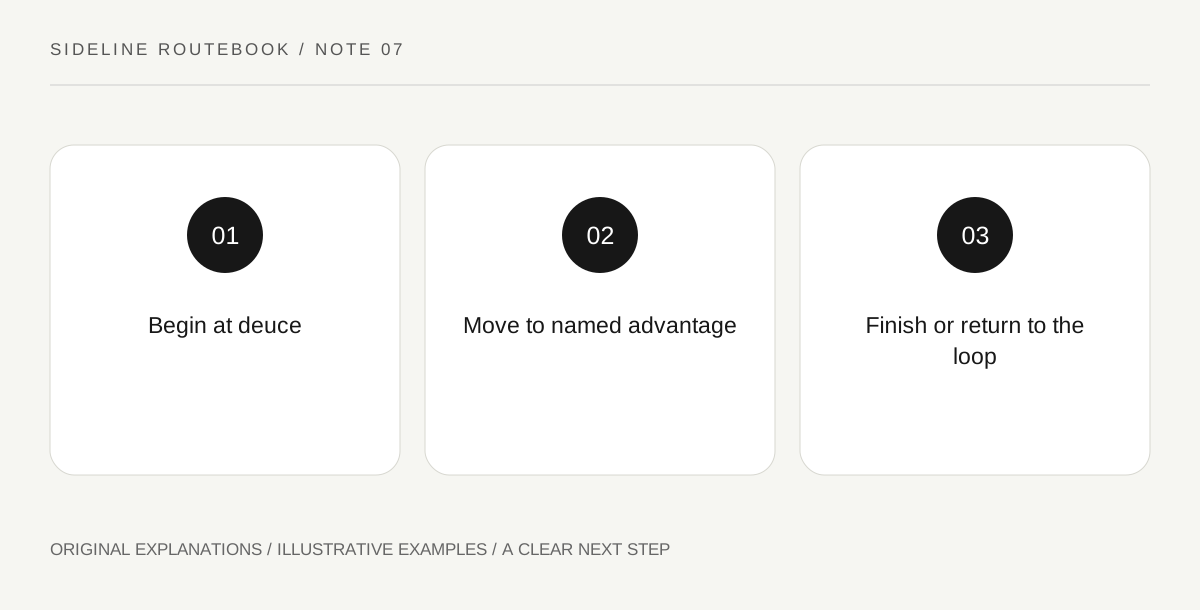
Racket and court scores3 min read
In a standard advantage game, deuce is a state that can return, not a one-time milestone. Draw a small loop between deuce and advantage to follow the late points without counting every rally from the start. The exercise concerns a standard advantage game; an event using no-ad scoring follows a different finish.
Read the guide ↗
Racket and court scores3 min read
An ordinary tennis tie-break changes server after the first point and then uses two-point service blocks. A numbered slot strip makes that pattern easier to follow than guessing from the score. Fill the server names before the practice begins, then record point winners in a separate row so the two roles stay distinct.
Read the guide ↗
Racket and court scores3 min read
A tied late-game point score can lead to a deciding point or to an advantage loop, depending on the announced format. Put two fictional games side by side and follow what happens next. The comparison helps a viewer ask the right format question before assuming that every deuce will require two more points.
Read the guide ↗
Scorecard arithmetic3 min read
When a basketball score jumps, a short arithmetic note can help you understand what the display is counting. Separate successful scoring actions from possessions and shot attempts. This exercise uses ordinary FIBA point values and invented sequences, with no prediction of who will score next or assessment of a player’s performance.
Read the guide ↗
Racket and court scores3 min read
Two foul counters on a basketball display can rise after the same incident while measuring different things. Put individual history and the current team-quarter total on separate lines. This introductory FIBA viewing exercise helps you follow the display without assuming that every whistle means free throws or that a team total belongs to one player.
Read the guide ↗
Clocks and recorded play3 min read
A game clock measures playing time within a period, while your watch measures the whole viewing session. They answer different questions. Convert a few fictional FIBA clock readings into elapsed playing minutes, then keep intervals and stoppages outside that calculation rather than promising an exact real-world finishing time.
Read the guide ↗
Clocks and recorded play3 min read
A basketball broadcast can show two countdowns at once. The longer display places play within a quarter, while the shot clock sets a separate offensive timing constraint. Learn to name both before discussing urgency. This exercise compares invented display readings and does not try to reconstruct every reset rule from a highlight clip.
Read the guide ↗
Scorecard arithmetic3 min read
A tenpin strike can leave a frame total waiting for later deliveries. The key counting unit is rolls, not frames. Build a small window over the next two rolls and use invented score sequences to see why a run of strikes can keep several earlier totals unresolved at the same time.
Read the guide ↗
Scorecard arithmetic3 min read
A spare and a strike both create a bonus, but their waiting windows differ. For a spare, the next single roll supplies the bonus. Work through a few invented mid-game frames to see why the following frame’s second delivery does not change a spare that has already been resolved.
Read the guide ↗
Racket and court scores3 min read
A viewer arriving from another sport may expect the side that conceded to restart after every goal. Netball’s alternating centre-pass pattern needs a different notebook. Keep a pass-owner row alongside the score so that a run of goals by one team does not make you lose the next restart.
Read the guide ↗
Racket and court scores3 min read
A player catching the ball near a netball goal is not automatically a permitted shooter. Learn to identify the two shooting position labels, then observe where a shot is attempted. This narrow spectator lesson separates player role, court location and the eventual scoring outcome without attempting to explain every movement restriction.
Read the guide ↗
Clocks and recorded play3 min read
A chess move such as Nf3 combines a piece label with a destination square. Decode those two parts before trying to replay a long game. This beginner exercise uses a short invented opening and ordinary English algebraic notation, leaving captures, promotions and ambiguous-piece cases for later study.
Read the guide ↗
Scorecard arithmetic3 min read
A chess result line uses small numbers that do not count captured pieces. Separate the game result from tournament points and from any informal material evaluation. An invented three-round ledger shows how a player can accumulate standings points without adding the value of the pieces removed from the board.
Read the guide ↗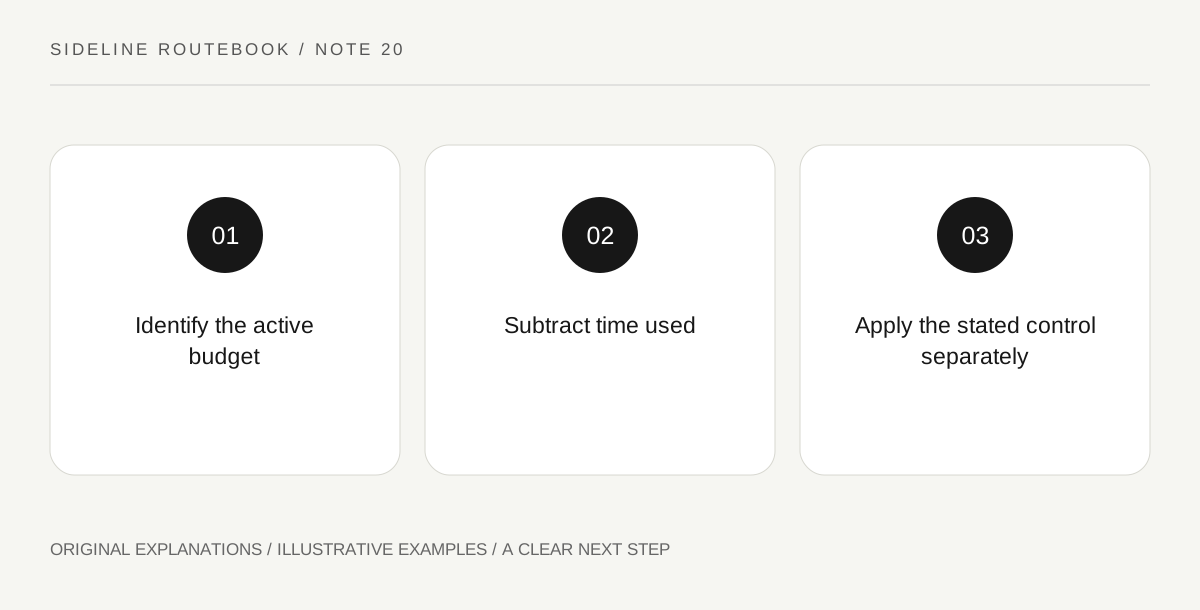
Clocks and recorded play3 min read
A chess display can show two time budgets even though only one is running during ordinary uninterrupted play. Learn which player’s clock is active, then distinguish time spent from time added by the announced control. This introductory exercise uses invented numbers and avoids making a result claim from a single low clock reading.
Read the guide ↗