Write the service slots before watching a tennis tie-break
An ordinary tennis tie-break changes server after the first point and then uses two-point service blocks. A numbered slot strip makes that pattern easier to follow than guessing from the score. Fill the server names before the practice begins, then record point winners in a separate row so the two roles stay distinct.
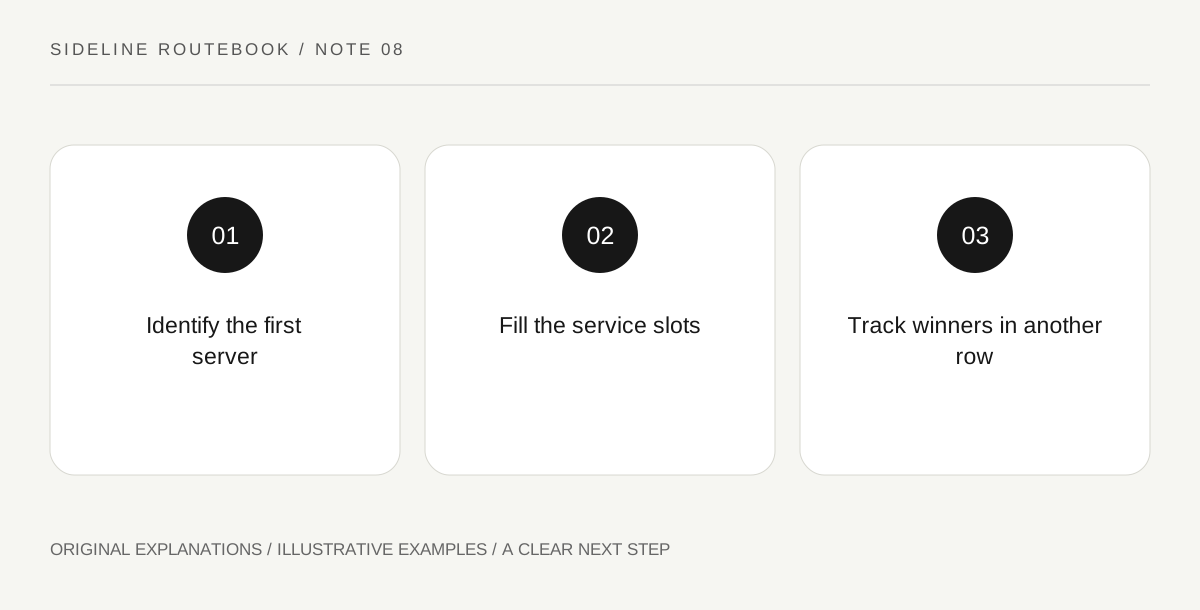
Original explanatory diagram. Read the full method and limitations below.
Define the ordinary sequence
USTA’s officiating explanation describes the player whose turn it is serving the first tie-break point, followed by the opponent serving the next two, with two-point blocks alternating afterward. Label the starting server A for the exercise. This is a service-order lesson, not a claim that every tie-break in every event has the same winning target. Put the applicable target and margin elsewhere if you also want to track when a particular tie-break will end.
Number the slots across the page
Write point slots one through eleven. Under them, write A, B, B, A, A, B, B, A, A, B, B. Read them aloud in groups: one for A, two for B, two for A. The first single slot is the part that often gets lost when viewers remember only the phrase two serves each. Leave space below the strip for later points; the pattern can continue without starting the numbering again.
Give point winners a separate row
Below each server slot, record who wins that point. A server can lose a point and still serve the next slot in a two-point block. If you use only one row of names, it becomes easy to mistake the winner for the next server. Try coloring or underlining the server row while keeping the winners plain. This is a paper distinction, so it does not require knowing how the broadcast marks the server beside a player’s name.
Recover after a missed point
If you return from a distraction, find the total number of points already played by adding the two displayed point scores, then locate the following slot. This is an arithmetic recovery technique for the ordinary sequence you wrote down, not a ruling about a service-order error. Verify the starting server if you did not see the beginning. A correct slot pattern attached to the wrong initial name will remain consistently wrong until that assumption is repaired.
An original illustrative exercise
In an invented tie-break started by A, the display reaches 3–2 after five points. Five slots are complete, so point six belongs to B in the written sequence. Suppose A won points four and five while serving; that does not grant A the sixth service slot. The separate winner row prevents that mistaken inference. The example practices sequence recovery and gives no real match result.
Questions that come up
Does the winner of a point choose who serves next?
No. In this ordinary tie-break service sequence, the service slots are set by order. A point winner can be different from the server, which is why the exercise records them separately.
Can I use the same strip for an unfamiliar special format?
Only after verifying that its service order matches. The strip teaches the ordinary ITF sequence; an event’s announced alternative format should be checked before importing its target or other conditions.
References and scope
These sources support the factual background. Examples and exercises are original illustrative teaching material. References do not imply endorsement.
- USTA — The AD-Inbox, officiating explanations — The first single service slot followed by alternating two-point blocks; no other questions or rulings from the mailbag are reproduced.