Keep a VAR check, a review and a final decision separate
A pause and a replay montage can make every VAR situation look identical. A three-line record helps you follow the process: information being checked, a review if initiated and the referee’s final decision. It also keeps a television commentator’s prediction from quietly becoming your record of what the officials actually decided.
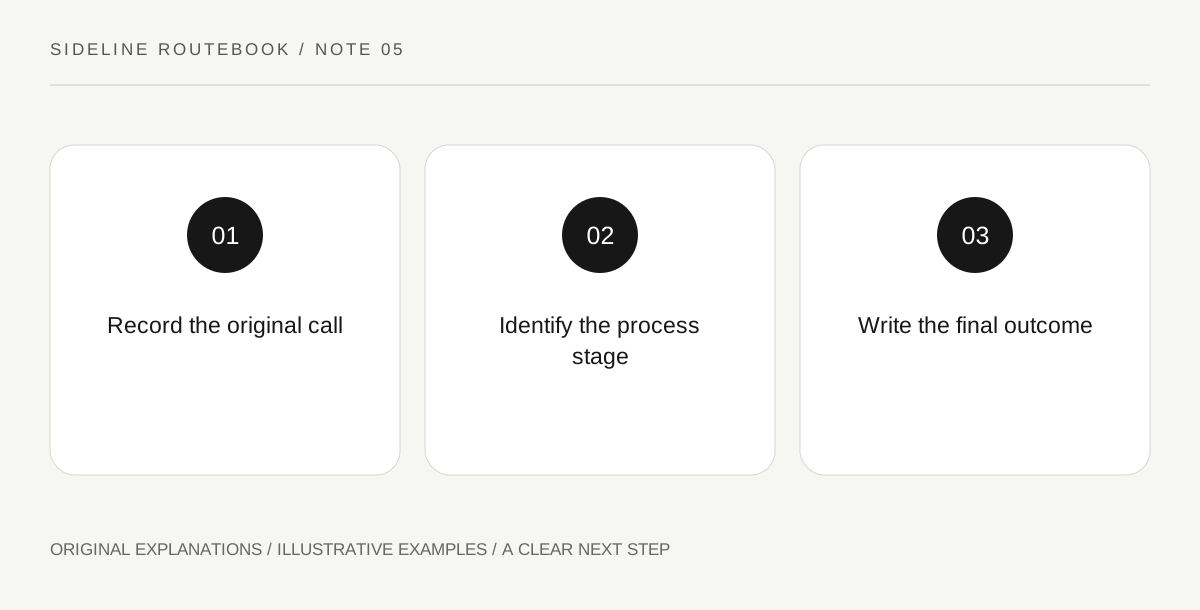
Original explanatory diagram. Read the full method and limitations below.
Write the original on-field outcome
Before discussing a replay, note the decision that spectators initially saw, using plain terms such as goal given or penalty not awarded. If you missed it, say so. This first line creates a reference point for the later outcome. Without it, a viewer can say the decision changed when the final result merely confirmed the original call. Your note should identify the event being considered without inventing a private conversation between officials.
Treat a check as an information stage
The IFAB protocol distinguishes automatic checks from reviews, with some checks remaining silent. A broadcast may announce checking while the referee is receiving information. On your second line, record the language actually shown or heard, placing commentary in quotation marks only in your private notes if useful. Do not translate every replay into the claim that a formal on-field review is happening. The television director can show slow motion for viewers independently of an official process.
Look for the kind of review shown
A review can involve the referee looking at the pitchside screen or deciding with information from the VAR. Therefore, no screen visit does not by itself prove that no review occurred. Describe the visible procedure rather than assigning the decision to a screen operator. The referee retains the final decision under the protocol. Keep your note short enough to update when the official communication arrives, especially if the broadcast initially mislabels the stage.
Close the record with the communicated outcome
On the last line, write the final decision and any clearly communicated explanation. Place an unresolved question beside it if the broadcast did not explain the relevant issue. The length of the pause does not answer whether the decision was right, and a dramatic crowd reaction does not supply the missing reason. Comparing your three lines afterward can reveal whether you followed an actual change, a confirmation or a sequence whose original decision you never saw.
An original illustrative exercise
Imagine an invented incident with goal initially awarded. The broadcaster displays checking, then shows the referee communicating a final goal decision without a screen visit. The viewer’s record says original goal, check announced, final goal. They do not label the pause a reversal, and they do not infer from the missing screen visit that there was no video involvement. The example teaches process reading rather than reviewing a real incident.
Questions that come up
Does a long check imply a reversal is coming?
No. Duration alone does not tell you the final decision. Keep time spent separate from the recorded outcome and wait for the official communication before updating the score or decision in your notes.
Is every television replay part of the official review?
No. A broadcaster also chooses replays for viewers. The presence of slow motion on your screen is not enough to identify the official stage or establish exactly what information officials are considering.
References and scope
These sources support the factual background. Examples and exercises are original illustrative teaching material. References do not imply endorsement.
- IFAB — VAR protocol — Checks, reviews and the referee’s final decision are distinct stages.