Follow the deuce loop without inventing a new game score
In a standard advantage game, deuce is a state that can return, not a one-time milestone. Draw a small loop between deuce and advantage to follow the late points without counting every rally from the start. The exercise concerns a standard advantage game; an event using no-ad scoring follows a different finish.
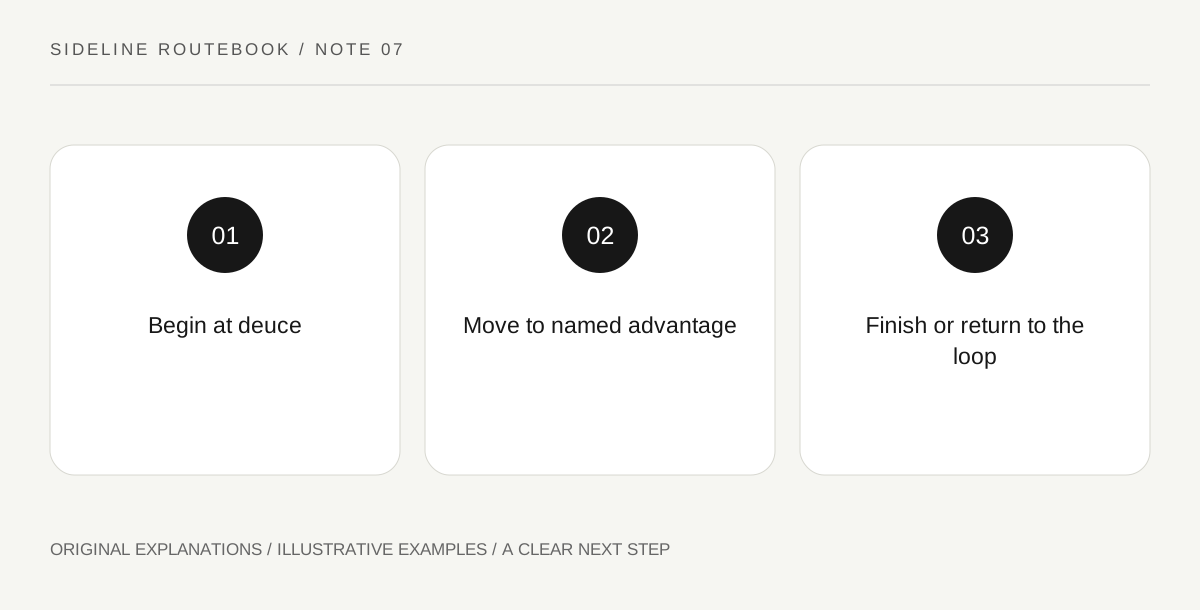
Original explanatory diagram. Read the full method and limitations below.
Choose the scoring system first
Write standard advantage at the top of the sheet. Under the ITF’s standard game format, deuce is followed by advantage for the player winning the next point; that player must win the following point to take the game, otherwise the score returns to deuce. That is the small rule core for this exercise. Do not mix it with an alternative deciding-point format, because the same looking tied point score can lead to a different ending there.
Draw three states rather than a long tally
Put deuce in the middle and advantage A and advantage B on either side. Add a separate game box farther away. From deuce, the next point selects one advantage box. From either advantage box, a point for that same player reaches game, while a point for the opponent returns to the middle. Use a movable pencil dot rather than redrawing the whole diagram. The layout shows why repeatedly trading points can leave the game unfinished.
Narrate two-point passages
Try speaking in small passages: A earns advantage, B returns the game to deuce. Then try B earns advantage, B wins the game. These sentences identify both the point winner and the resulting state, which are easy to confuse when commentary becomes excited. You do not need to estimate momentum or say that one player deserves the game. The exercise tracks the scoring consequence of each point, leaving tactical interpretation for a separate discussion.
Use a tally only for a different question
If you want to count total deuces or points played, keep that statistic underneath the state diagram. It answers a different question from who is currently ahead in the game. A long rally and a short rally can each move the marker one step. Keeping duration, point totals and current score separate makes the loop readable even during an extended game. Stop the practice once you can trace a return to deuce without losing which player had advantage.
An original illustrative exercise
Starting at deuce in an invented standard game, the point winners are B, A, A, B, B, B. The marker travels to advantage B, deuce, advantage A, deuce, advantage B and finally game B. The six-point sequence is fictional and does not reproduce a match. Its purpose is to show that the last two consecutive points from deuce finish the loop, while earlier traded points return it to the center.
Questions that come up
Does advantage mean the game has already been won?
No. It identifies the current position within the standard game. The next point either completes that game for the player with advantage or returns the score to deuce.
Why not just keep a normal number count?
You can record individual points, but a state diagram maps directly to the announced score. It reduces the need to reconstruct a long sequence every time the game returns to deuce.
References and scope
These sources support the factual background. Examples and exercises are original illustrative teaching material. References do not imply endorsement.
- ITF — 2026 Rules of Tennis — The standard advantage-game loop and the alternative no-ad deciding point. The comparison diagrams and point sequences are original.