Split an offside discussion into position and involvement
A still image of an attacker ahead of a defender can start an argument without answering the whole offside question. Build a two-question observation card: where was the player at the relevant moment, and how did that player become involved? The separation makes a replay easier to describe without pretending to officiate it.
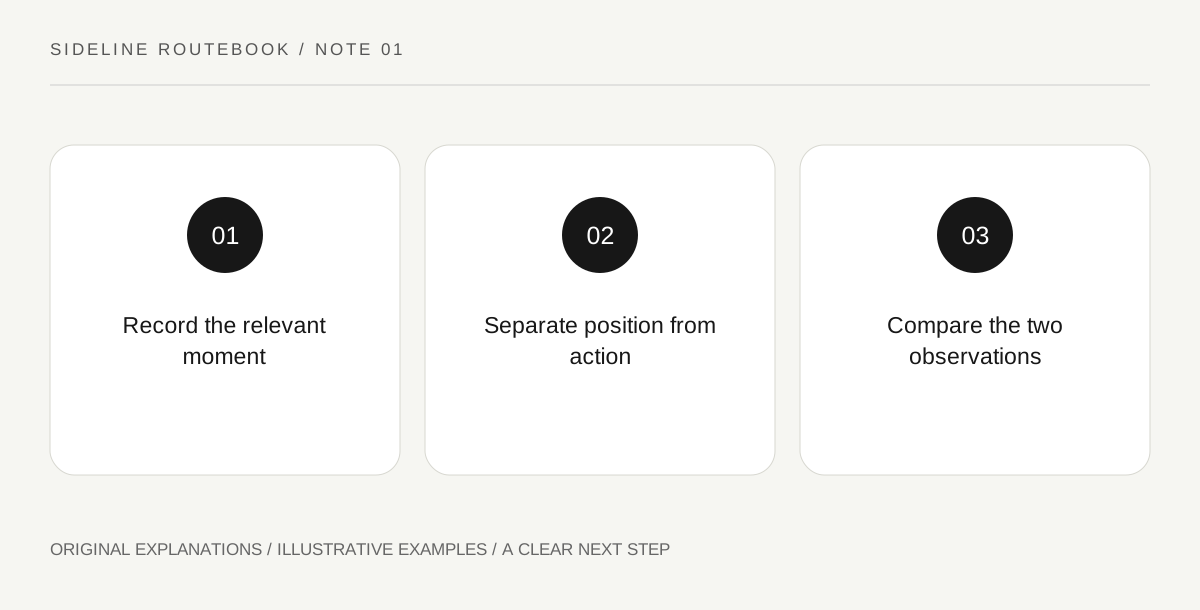
Original explanatory diagram. Read the full method and limitations below.
Make two spaces on the page
Label the first space position and the second involvement. IFAB Law 11 distinguishes being in an offside position from committing an offside offence through active involvement. Keep that narrow distinction at the top of the card. Do not use one dramatic image as a substitute for the sequence. Your purpose is to record which question an image might help answer, so the two spaces should remain separate even when a commentator gives a confident verdict.
Place the snapshot on a short timeline
For a simple teammate-pass illustration, mark the teammate’s touch before drawing where the recipient later receives the ball. Use plain arrows and player labels rather than trying to reproduce a broadcast’s calibrated lines. A later receiving position does not describe the earlier snapshot. If the replay does not show the relevant touch clearly, write timing unclear beside the position space. That is a specific missing observation, much more useful than filling the card with a guessed distance.
Describe the next action in ordinary words
In the second space, record what the player actually does next: plays the pass, remains away from it or appears to affect an opponent. The official law has detailed involvement tests and exceptions, which this small card does not replace. Distinguish an observable action from your interpretation of its effect. For example, writing runs toward the ball leaves a clearer record than writing obviously guilty, particularly when the camera cuts away before the action finishes.
Compare descriptions before debating the call
Ask a fellow viewer to describe the same sequence using your two spaces. You may discover that you agree about the player’s later location but disagree about which touch the replay is showing. Resolve that observation first. If an official explanation identifies a different issue, add it beside the relevant space rather than erasing the sequence. The card becomes a way to learn what evidence belongs to each question, not a collection of verdicts from uncalibrated camera angles.
An original illustrative exercise
Imagine a fictional replay in which player A passes toward player B while player C is farther forward. A viewer’s first note says C is forward, so offside. On the two-space card they instead note C’s position and separately record that B receives the pass. They still need the full involvement context for C; the exercise shows why a position label alone is not a complete decision.
Questions that come up
Does being beyond one defender settle position?
No. That description omits other parts of the position test, including the ball and second-last opponent. Use the official law for the complete test rather than treating this observation card as a shortcut.
Can I use this card for complicated rebounds?
You can record the timeline, but rebounds, deliberate play and other detailed situations require the relevant parts of Law 11. The simple teammate-pass exercise is deliberately narrower than those interpretations.
References and scope
These sources support the factual background. Examples and exercises are original illustrative teaching material. References do not imply endorsement.
- IFAB — Law 11, offside — Position and involvement are separate parts of an offside decision; our paper observation exercises are original.