Read GS and GA before judging a netball shooting opportunity
A player catching the ball near a netball goal is not automatically a permitted shooter. Learn to identify the two shooting position labels, then observe where a shot is attempted. This narrow spectator lesson separates player role, court location and the eventual scoring outcome without attempting to explain every movement restriction.
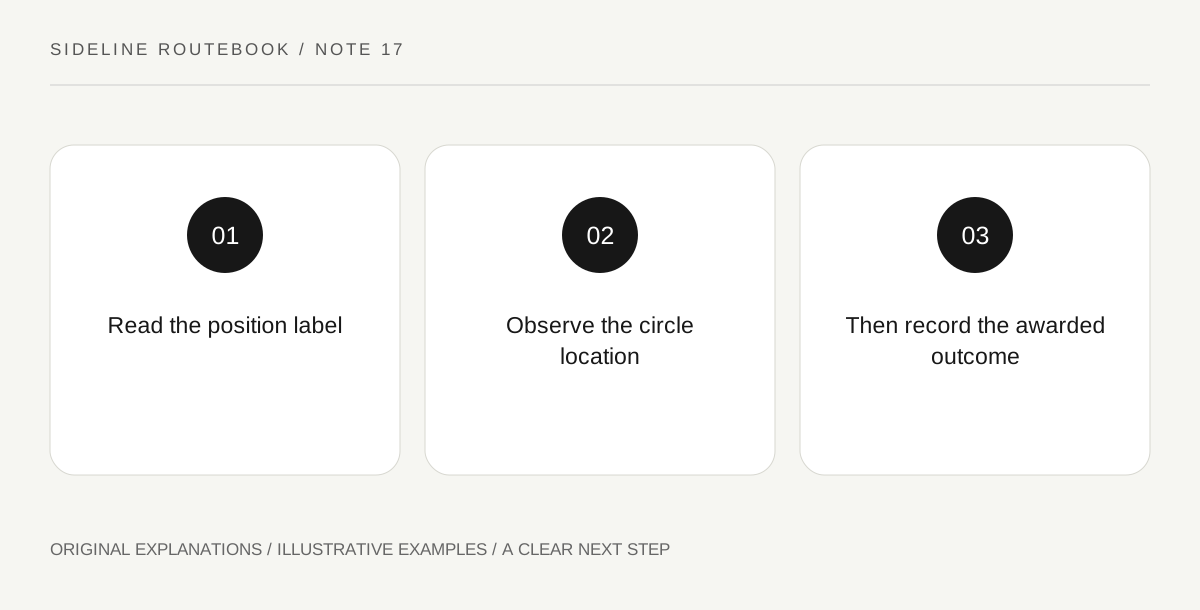
Original explanatory diagram. Read the full method and limitations below.
Put the two shooting labels on a card
The World Netball rules identify Goal Shooter, GS, and Goal Attack, GA, as the players who may score from within the goal circle. Write those two abbreviations beside their full names. This is the selected rule fact for the lesson, not a complete position map. Other position labels still matter in the game, but you do not need to memorize all their permitted areas before learning to recognize the two shooting roles.
Identify the current bib rather than a familiar name
When watching, locate GS and GA on the team’s current bibs or confirmed lineup. A player’s reputation, height or usual role is not enough to identify the position being used at that moment. If the camera angle hides the letters, note that uncertainty. This habit is particularly useful when a broadcast follows the ball tightly and several players converge near the circle. The closest person to the post is not necessarily the permitted shooter in that passage.
Separate eligibility from location
Make two check spaces labeled shooting role and goal-circle location. A suitable role alone does not describe where the shot was taken, and proximity alone does not establish the role. In a simple paper drawing, put one GS marker inside the circle and one different position outside it. Describe each using both labels. This is a recognition exercise, so avoid turning a rough sketch into a ruling about foot placement, contact or any other detailed incident.
Record the result only after the attempt
Add a third space for the awarded outcome. A permitted shooting role does not guarantee that an attempt becomes a goal; the attempt and its result remain distinct. You can use the three spaces while watching one short passage, then stop taking notes and follow the next normally. The point is to build a useful vocabulary for what you see, not to write a complete play-by-play or criticize players for choices you cannot fully observe.
An original illustrative exercise
In an invented viewing exercise, a learner sees a bib marked GA receive inside the goal circle and records role identified, location observed, outcome pending. The ball then goes through and the goal is awarded, so the final space is completed. In a second drawing, a nearby marker has a different bib, reminding the learner that being close to the post does not alone answer the role question. Neither illustration depicts a real contested decision.
Questions that come up
Does this card describe every area GS and GA may enter?
No. It focuses on recognizing the shooting roles and the goal-circle condition. A complete court-area map and other restrictions should come from the official rules rather than being inferred from this small card.
Is every catch near the post a shooting chance for that catcher?
Not necessarily. Identify the current position label and location before interpreting the opportunity. A player can be involved in a scoring passage without being the person permitted to take the shot.
References and scope
These sources support the factual background. Examples and exercises are original illustrative teaching material. References do not imply endorsement.
- World Netball — Rules of Netball 2024 — Goal Shooter and Goal Attack may score from within the goal circle; this is a narrow spectator primer.