Read the basketball game clock and shot clock as a pair
A basketball broadcast can show two countdowns at once. The longer display places play within a quarter, while the shot clock sets a separate offensive timing constraint. Learn to name both before discussing urgency. This exercise compares invented display readings and does not try to reconstruct every reset rule from a highlight clip.
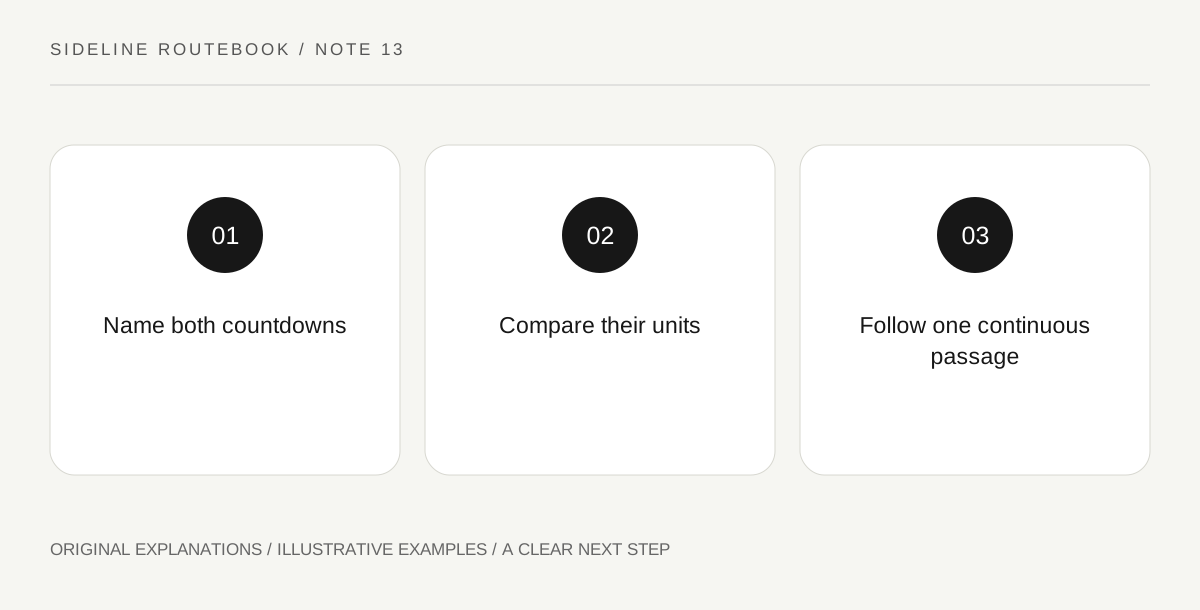
Original explanatory diagram. Read the full method and limitations below.
Give each display a job label
Draw two boxes labeled period remaining and shot clock. FIBA’s rules provide a separate shot-clock framework, including the ordinary twenty-four-second requirement in its stated conditions, rather than treating the period clock as the only timing limit. That narrow fact is enough for this reading exercise. The actual shot-clock value after a stoppage depends on the applicable situation, so avoid putting a universal reset number beside every change of camera or every whistle.
Copy the units before comparing size
Write a sample period display as 2:18 and a sample shot-clock display as 9 seconds. Translate the first into two minutes eighteen seconds and leave the second in seconds. Then ask which deadline is currently nearer. The answer in this invented pair is the nine-second display, but that does not mean the quarter has nine seconds left. Saying the unit aloud prevents a small broadcast number from being mistaken for the final moments of the period.
Follow one continuous passage
For practice, move both hypothetical displays forward by three seconds of uninterrupted running time. The period box becomes 2:15 and the shot-clock box six seconds. This deliberately simple passage isolates the idea of two clocks running together. Do not apply the subtraction across a whistle, change of control, rebound or correction without the relevant context. A real sequence can involve stops and resets; the paper exercise removes them so that the two roles are easy to see first.
Describe a mismatch as an observation
If a broadcast overlay and an arena display appear different, note which device you are reading and at what moment. Do not turn an edited or delayed image into a confident claim that a violation occurred. A shot’s release, the signal and the official display can require precise evidence. Your introductory note can simply identify both clocks and the visible uncertainty. That is sufficient for following the game’s pace without presenting a spectator’s screen as an officiating system.
An original illustrative exercise
An invented display shows quarter two, 7:42 remaining and a shot clock of 12. After four hypothetical uninterrupted seconds, the practice boxes read 7:38 and 8. A learner describes eight seconds on the shot clock, not eight seconds in the quarter. They leave all reset questions outside this example. The fictional arithmetic teaches paired units and makes no ruling about a real possession or a buzzer-beating shot.
Questions that come up
Must the shot clock always restart at twenty-four?
No. The official rules specify different procedures for particular situations. This introductory lesson does not teach those resets, so use the relevant rule and the actual context before judging a displayed value.
Can I decide a violation from a paused highlight?
A paused edited image may omit crucial timing or display information. Use it to identify a question, but a precise decision requires the appropriate official evidence and the full relevant sequence.
References and scope
These sources support the factual background. Examples and exercises are original illustrative teaching material. References do not imply endorsement.
- FIBA — Official Basketball Rules 2026 v1.1 — Effective 1 October 2026: point values, distinct foul counters, quarter lengths and the separate shot clock. Arithmetic exercises are invented.