Translate a basketball quarter clock without predicting the finish time
A game clock measures playing time within a period, while your watch measures the whole viewing session. They answer different questions. Convert a few fictional FIBA clock readings into elapsed playing minutes, then keep intervals and stoppages outside that calculation rather than promising an exact real-world finishing time.
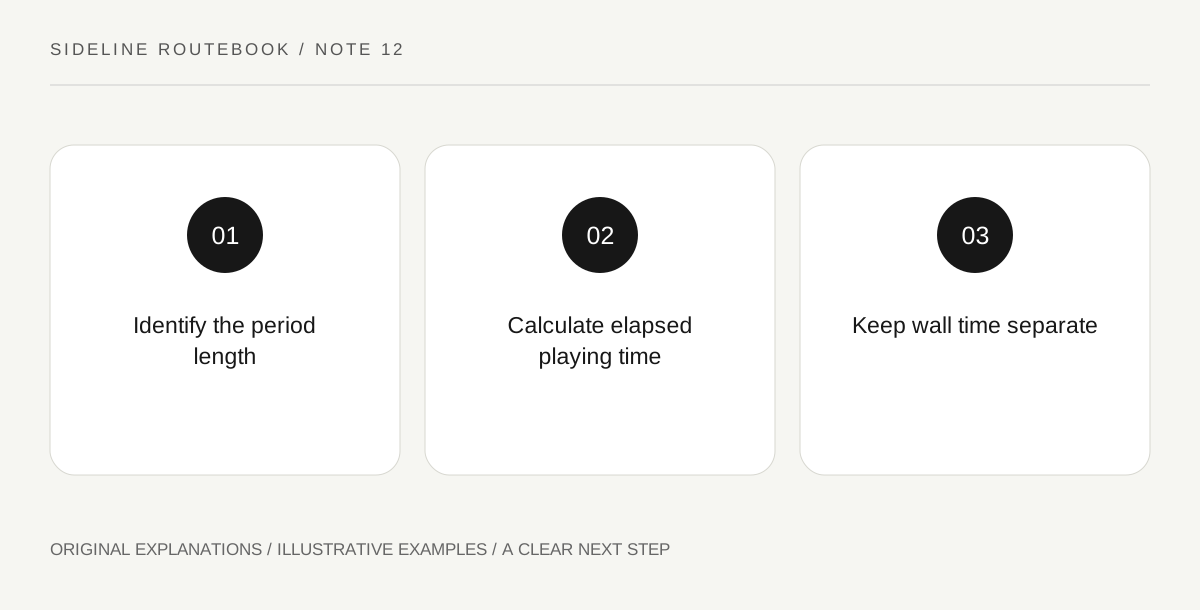
Original explanatory diagram. Read the full method and limitations below.
Write the period structure explicitly
FIBA’s 2026 rules use four ten-minute quarters, with five-minute overtimes when needed to resolve the relevant tie. Put the ordinary four-quarter structure at the top of a practice page. This is not a universal basketball schedule; other rule systems can use different period lengths. The exercise’s calculations stay within the stated FIBA structure, so name that context whenever sharing the result with someone watching a different competition or a different version of the sport.
Subtract remaining time from the quarter length
For an ordinary quarter, ten minutes minus the displayed time remaining gives elapsed playing time in that quarter. At 6:30 remaining, the arithmetic gives 3:30 elapsed. Practice subtracting seconds carefully rather than treating a clock as a decimal number. Six minutes thirty seconds is not six point three minutes. Use a small minutes-and-seconds column if needed, or convert both readings to seconds and convert the answer back afterward.
Add completed quarters only for a playing-time total
If the second quarter shows 6:30, one completed ten-minute quarter plus 3:30 in the active quarter gives 13:30 of ordinary game-clock time elapsed. Label that answer playing time elapsed. It does not include the pregame period, interval, stoppages or anything else counted by your wall clock. This labeled total can help you place a clip within a game’s structure, but it cannot tell you how long a spectator has already been watching.
Make a flexible viewing plan
For a real session, write the published start time and leave the finish flexible. A close ending, interruptions or overtime can extend wall time, while an edited replay can shorten the recording you are watching. If you must leave at a fixed time, plan around that personal boundary rather than calculating an assured finish from the remaining playing minutes. Keeping the two clocks separate produces a more useful plan than an exact-looking estimate built from an incomplete time budget.
An original illustrative exercise
In a fictional FIBA game, quarter three shows 4:20. The learner calculates 5:40 elapsed in that quarter and adds twenty completed minutes, giving 25:40 of game-clock time. Their watch says the viewing session began much earlier. Both readings can be correct because they measure different intervals. The example explains a conversion; it is not a promise about an event’s running time or a transport departure afterward.
Questions that come up
Can forty playing minutes tell me the broadcast duration?
No. The broadcast also includes time that is outside the running game clock, and the match may require additional periods. Use the scheduled program information as context while allowing flexibility for the actual event.
Why does 6:30 not equal 6.30 minutes?
A clock’s seconds field uses sixty seconds per minute. Decimal minutes use fractions of a hundred, so copying the digits directly into decimal arithmetic produces the wrong duration.
References and scope
These sources support the factual background. Examples and exercises are original illustrative teaching material. References do not imply endorsement.
- FIBA — Official Basketball Rules 2026 v1.1 — Effective 1 October 2026: point values, distinct foul counters, quarter lengths and the separate shot clock. Arithmetic exercises are invented.