Decode a simple chess move without reading the whole scoresheet
A chess move such as Nf3 combines a piece label with a destination square. Decode those two parts before trying to replay a long game. This beginner exercise uses a short invented opening and ordinary English algebraic notation, leaving captures, promotions and ambiguous-piece cases for later study.
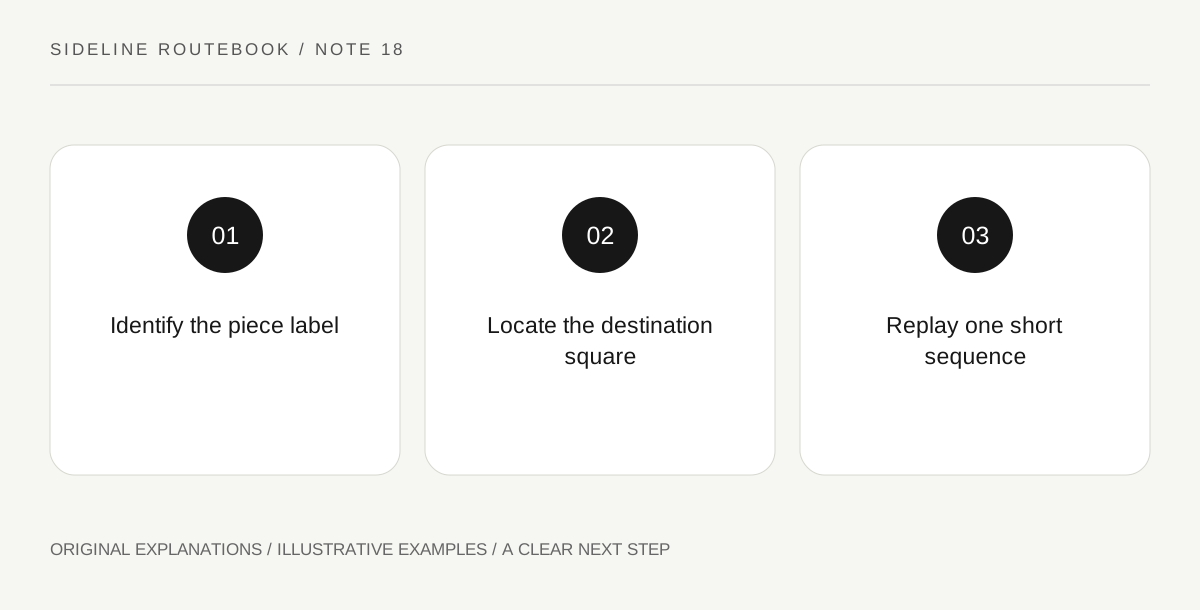
Original explanatory diagram. Read the full method and limitations below.
Make a small English piece key
The United States Blind Chess Association’s notation lesson uses English piece letters K, Q, R, B and N, with N identifying a knight. Pawn moves omit a piece initial. Put that compact key beside an empty practice board. This lesson uses only the simplest arrival-square form, so it does not attempt to compress every notation convention into a single chart. A limited key is useful when each entry can be recognized and applied immediately rather than memorized as an unexplained string.
Read the destination as a coordinate
The square name combines a file letter and rank number. Find the named square on a correctly labeled board before moving anything. In Nf3, identify N as the piece type and f3 as the destination; the text does not say that N is a file or that three knights move. For a simple pawn move such as d4, the lack of a piece initial is meaningful. Separate that omission from a printing error in your reading exercise.
Replay only a short legal sequence
From the ordinary starting position, try the invented sequence 1.d4 d5 2.Nf3 Nf6. Locate each destination and move the appropriate piece in turn. Keep White’s and Black’s entries in separate columns so that a move number does not get mistaken for a piece count. Stop after the short sequence and compare the board with the words you decoded. This is enough to practice the basic pattern without borrowing an annotated game or claiming the moves are best.
Leave unfamiliar marks as named questions
When you later see an extra file letter, a capture mark, a promotion suffix or a castling symbol, put that notation in a small questions list. Do not strip the unfamiliar part away and assume the rest tells the complete move. The basic decoder is an entry point, not a parser for every possible scoresheet. Learning one new symbol against an actual board position is more reliable than guessing several unfamiliar conventions while trying to follow rapid commentary.
An original illustrative exercise
A fictional learner reads 1.d4 d5 2.Nf3 Nf6 from the starting position. They move the two d-pawns, then the White knight to f3 and the Black knight to f6. They describe N as a piece label and f3 as its destination, while d4 needs no pawn initial. The sequence is an original practice example, not opening advice, an evaluation or an excerpt from a reported tournament game.
Questions that come up
Is N a board-file letter in Nf3?
No. In the English piece key here, N means knight. The destination square is f3, which combines its file letter with its rank number. Keeping the parts separate makes the short move readable.
Can every move be read with just these two parts?
No. Captures, promotions, castling and cases needing disambiguation add conventions. This lesson intentionally covers a simple starting pattern, so use the full notation appendix when an extra mark changes the meaning.
References and scope
These sources support the factual background. Examples and exercises are original illustrative teaching material. References do not imply endorsement.
- United States Blind Chess Association — Chess Notation — English piece labels, file/rank square names and basic piece or pawn arrival notation. The short practice sequence is original, not the source’s reproduced sample game.