Count a strike bonus by rolls instead of frames
A tenpin strike can leave a frame total waiting for later deliveries. The key counting unit is rolls, not frames. Build a small window over the next two rolls and use invented score sequences to see why a run of strikes can keep several earlier totals unresolved at the same time.
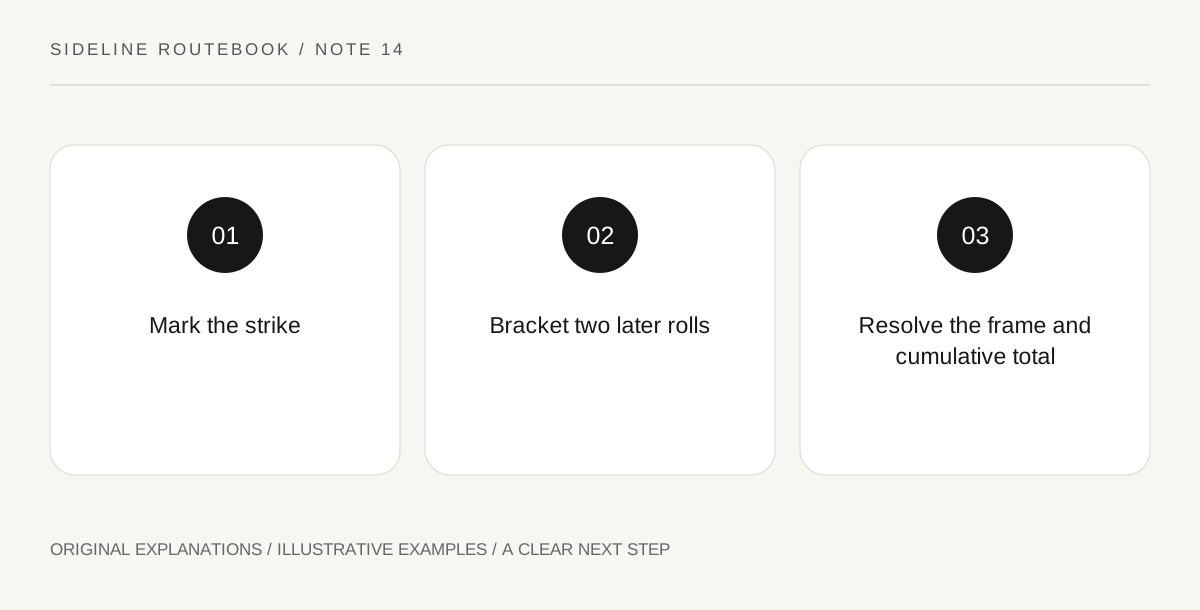
Original explanatory diagram. Read the full method and limitations below.
Separate the delivery row from the frame row
The USBC scoring guide describes a strike as ten pins on the first roll, with the next two rolls supplying its bonus. Write deliveries across one row and mark frame boundaries underneath. This original two-row exercise makes the unit visible. If you write only one symbol per frame, it is easy to mistake two later frames for two later rolls, especially when those frames contain different numbers of deliveries.
Open a two-roll window after the strike
Draw a bracket immediately after a strike symbol and let it cover exactly two later deliveries. Suppose those rolls knock down six and two. The strike frame’s value is ten plus six plus two, or eighteen. The later frame still has its own value; using its rolls as a bonus does not erase it. Keep the strike’s frame value in one box and the running cumulative score in another, so you do not add a previous total twice.
Try a window that crosses frame boundaries
Now imagine a strike followed by another strike and then a four-pin first roll. The first strike’s bonus window contains ten and four, producing twenty-four for that first frame. The second strike still needs its own next two rolls. This is why an automatic display can show a later symbol while an earlier cumulative total remains pending. A blank total may simply mean the bonus information is not complete, rather than that the scoring system has stopped counting.
Reconcile a pending total patiently
Label unresolved frames waiting for two or waiting for one as the sequence develops. Fill a frame value only when its bonus window is complete, then add it to the prior cumulative total. Do not force every box to contain a final number after every delivery. This exercise stays with ordinary earlier frames; the tenth frame’s extra-roll arrangements require their own attention. Mastering the roll window first gives you a clear foundation for that separate end-of-game procedure.
An original illustrative exercise
In an invented sequence, frame two is a strike, frame three is another strike and the next delivery knocks down four. The frame-two value becomes 10 + 10 + 4 = 24. If the cumulative score after frame one was seven, the cumulative total through frame two is 31. The second strike is still pending. These fictional values demonstrate why frame value, cumulative total and unresolved later frame are three separate entries.
Questions that come up
Does a strike bonus mean the next two whole frames?
No. The bonus uses the next two rolls. Those rolls may fall within one later frame or cross frame boundaries, depending on the deliveries that follow.
Are the bonus pins removed from their own frame?
No. A later delivery can contribute to an earlier bonus while still belonging to its own frame’s scoring. The exercise uses separate rows so those roles remain visible rather than being treated as a transfer.
References and scope
These sources support the factual background. Examples and exercises are original illustrative teaching material. References do not imply endorsement.
- USBC — Keeping Score — Strike and spare bonus-roll definitions. The frame sequences below are our own examples.