Read a tennis score in four different units
A tennis display may show sets, games and the current point score beside the same two names. Read those numbers as different units rather than one large arithmetic total. A small nested score ladder helps you locate the part of the match that a commentator is discussing and avoid adding unrelated columns together.
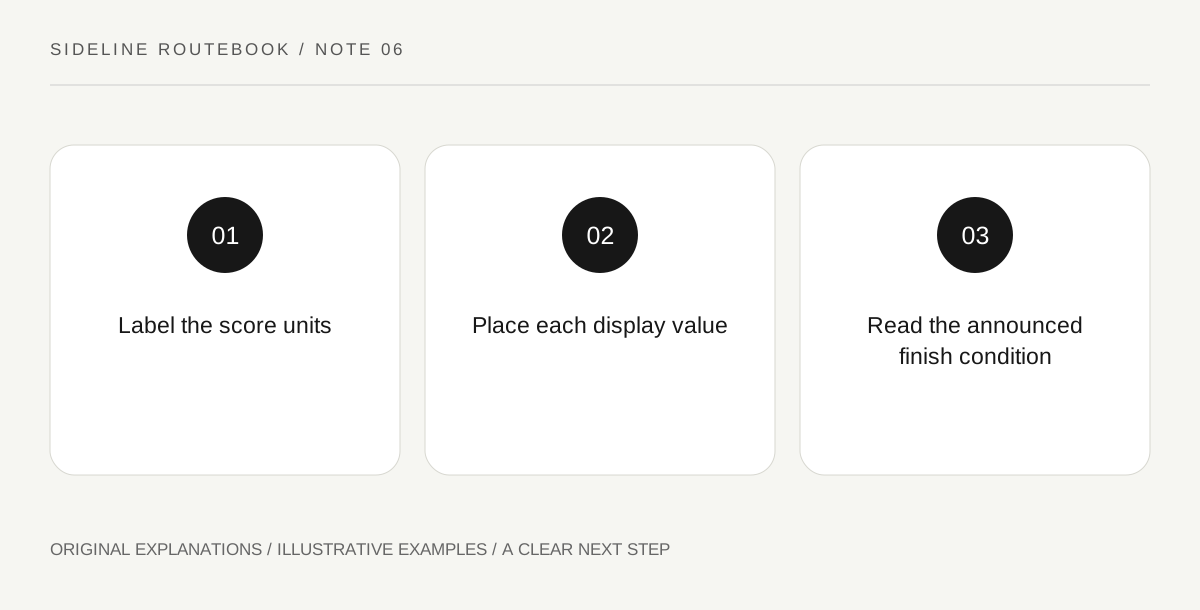
Original explanatory diagram. Read the full method and limitations below.
Give the columns explicit labels
On a practice sheet, create spaces labeled match, sets, current set games and current game points. USTA’s scoring guide distinguishes games, sets and the match; this is a reading exercise built around that hierarchy. Copy a display’s labels before copying its numbers. Some broadcasts arrange completed set scores horizontally while showing the active game separately, so the visual location alone is not a reliable unit. A number becomes useful only when you know what it is counting.
Trace one point upward only when appropriate
Imagine that a point changes the current game display but does not finish the game. Mark the point box and leave the game and set boxes unchanged. This is the central movement in the exercise: most point updates do not immediately alter every level. Later, when a game ends, update the game count and start a fresh point box. You can follow that hierarchy without yet learning every possible scoring format or deciding who will win.
Keep completed sets separate from the live game
Draw a border around completed set scores so that they remain historical information. Place the active set’s game count beside the current point box. If you see a small superscript or another tie-break annotation, record it as an annotation to investigate rather than adding it to the games. The ladder should make the display easier to narrate: one player won the first set, the current set stands here and this game has reached this point score.
Read the event’s format before predicting the finish
The match format determines what counts as enough sets, while set formats can also differ. Add the event’s announced format in the match space instead of importing the format of the last tournament you watched. If you cannot find it, you can still describe the current display accurately without predicting match point. Separating description from prediction prevents a correct reading of the numbers from being extended into an incorrect claim about how close the match is to ending.
An original illustrative exercise
On an invented display, the first completed set reads 6–3, the current set reads 2–4 and the live point score reads 30–15. A learner places those three pairs in separate boxes. They do not add 6, 2 and 30, and they do not call 4 the number of sets won. Their spoken summary identifies the finished set, current games and live points in that order.
Questions that come up
Must every broadcaster arrange the columns the same way?
No. Use the displayed labels and the unfolding play to identify the units. The ladder is a private translation aid, so it can remain consistent even when different broadcasts use different visual arrangements.
Can I learn the hierarchy before every scoring exception?
Yes. Recognizing the units is useful first. When a special tie-break or alternative set format appears, you can investigate that part while retaining the distinction between points, games, sets and the match.
References and scope
These sources support the factual background. Examples and exercises are original illustrative teaching material. References do not imply endorsement.
- USTA — Tennis Scoring: Points, Sets and Games — The distinct points, games, sets and match score units. The nested reading ladder and invented display are original.