Resolve a spare without borrowing the whole next frame
A spare and a strike both create a bonus, but their waiting windows differ. For a spare, the next single roll supplies the bonus. Work through a few invented mid-game frames to see why the following frame’s second delivery does not change a spare that has already been resolved.
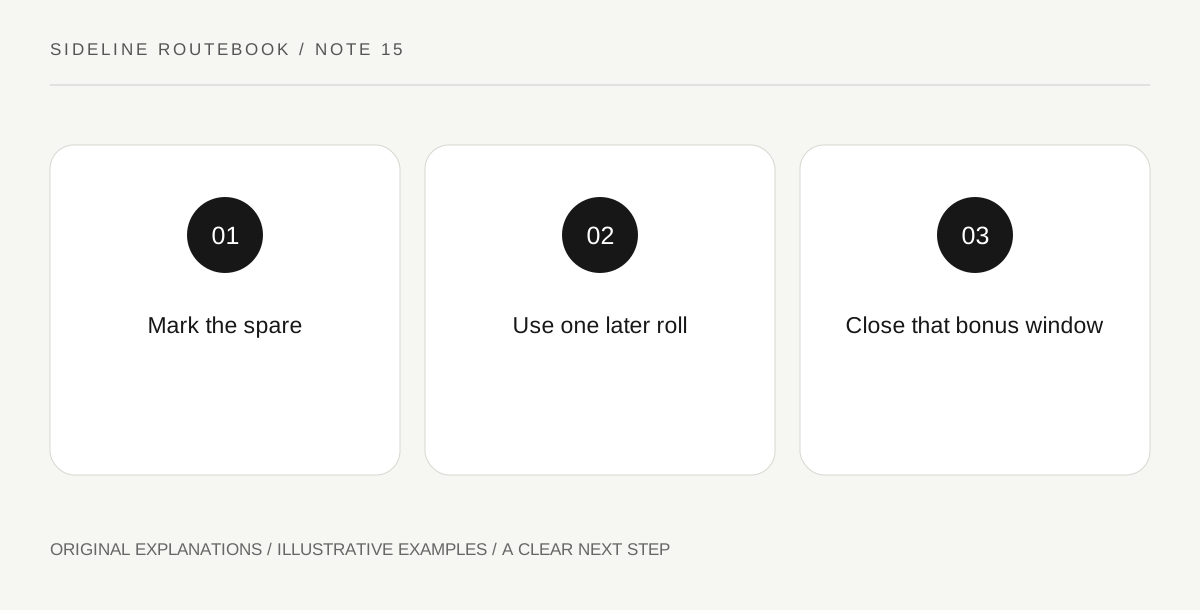
Original explanatory diagram. Read the full method and limitations below.
Make the spare’s small equation
The USBC guide defines a spare as clearing all ten pins in two rolls, with the next roll providing the bonus. Write spare value equals ten plus next roll at the top of the page in your own notation. This is the only official scoring fact needed for the exercise. Keep the example in ordinary earlier frames so the end-of-game extra-roll procedure does not distract from the difference between one bonus roll and an entire later frame.
Fill the next delivery, then stop the window
Imagine a frame containing seven pins followed by the remaining three, making a spare. The next frame’s first roll knocks down five. The spare frame is now worth fifteen. Draw a closing mark after that five-pin delivery to show that its bonus window is complete. If the next roll knocks down two more, those two belong in the next frame’s own record but do not get added to the already resolved spare value.
Keep cumulative arithmetic in a second box
If the cumulative total before the spare was twenty-three, add the spare’s fifteen to reach thirty-eight through that frame. The following open frame of five and two adds seven, giving forty-five through the next frame. Write the three steps in distinct boxes: spare value, cumulative through spare and cumulative through next frame. This separation prevents a common confusion in which a learner remembers fifteen and accidentally treats it as the entire game total.
Compare two possible next frames
Try two invented continuations after identical spares: first five then zero, and first five then four. The spare value is fifteen in both continuations because the bonus roll is the same. The following frame values differ. This controlled comparison changes only the second delivery and makes its effect easy to locate. It is more informative than a long random game because you can explain exactly which box should change and which should remain fixed.
An original illustrative exercise
Two fictional practice cards begin with the same spare and a previous cumulative total of eleven. Both next first rolls knock down six, so both spare frames are worth sixteen and both cumulative totals through the spare become twenty-seven. One next second roll is zero and the other is three. Only the next frame’s eventual contribution differs. The earlier spare does not become more valuable merely because the second delivery improved.
Questions that come up
Does the following frame’s second roll ever enlarge this spare bonus?
Not in the ordinary earlier-frame exercise here. The spare bonus has already been fixed by the next single roll, so the later second delivery belongs to the following frame’s own scoring.
Why practice two nearly identical sequences?
Changing one delivery at a time lets you see where that change belongs. It tests whether you understand the bonus window rather than merely reaching a total by copying a completed scoring sheet.
References and scope
These sources support the factual background. Examples and exercises are original illustrative teaching material. References do not imply endorsement.
- USBC — Keeping Score — Strike and spare bonus-roll definitions. The frame sequences below are our own examples.