Compare the last point of no-ad and advantage games
A tied late-game point score can lead to a deciding point or to an advantage loop, depending on the announced format. Put two fictional games side by side and follow what happens next. The comparison helps a viewer ask the right format question before assuming that every deuce will require two more points.
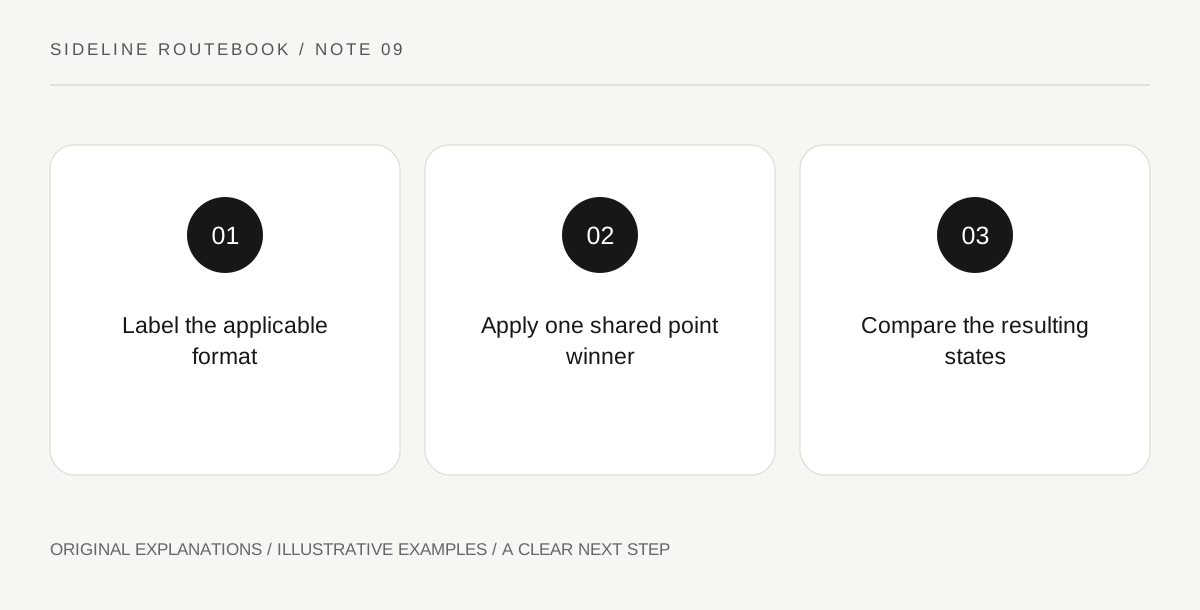
Original explanatory diagram. Read the full method and limitations below.
Label two different finish mechanisms
Write standard advantage above one column and no-ad above the other. The ITF rules include no-ad as an alternative format with a deciding point at three points each. This article uses that small difference to build an original comparison, rather than reproducing the full alternative-format rules. Read the event’s own scoring announcement before deciding which column applies, especially when switching between singles, doubles or different competitions on the same viewing day.
Begin both examples at the same tie
Place both fictional games at three points each. For the first column, use the familiar deuce label. For the second, mark next point decides. Now let player B win the next point in both columns. In the advantage game, write advantage B. In the no-ad game, write game B. The same fictional point winner produces different next states because the format is different, not because the scoreboard has made an arithmetic mistake.
Show where a return to deuce belongs
Continue only the advantage column with a point won by A. That column returns to deuce. Leave the no-ad column closed, because its game already ended in the comparison. This blank continuation is useful: it makes the difference visible without adding a complicated rally story. If you also want to study receiver-side choice or doubles-specific details, use the official alternative-format text separately rather than treating this two-column exercise as a complete procedure.
Translate the comparison into viewing notes
Before a close game, write one sentence naming the format and one naming the finish condition. A viewer can then say this is a deciding point rather than calling it advantage in anticipation. Avoid claiming a tournament always uses one system based on an old broadcast or a different draw. Your note needs only the format applying to the match being watched. Once that is clear, the late-game display becomes easier to narrate without introducing an incorrect extra point.
An original illustrative exercise
Imagine two practice games both tied after six points. B wins point seven. The no-ad column closes as game B; the standard advantage column reads advantage B. A then wins the next point only in the still-open advantage example, returning it to deuce. These are invented parallel exercises, not two real simultaneous matches. They isolate the format difference while holding the initial tie and next point winner constant.
Questions that come up
Does the word deuce always promise an advantage loop?
No. Commentators may describe a tied point score informally. The announced scoring format determines the next step, so identify it rather than relying on a familiar word alone.
Does this comparison explain all no-ad procedures?
No. It isolates the deciding-point finish. Receiver choices and doubles-specific conditions belong to the official format rules and should be read there when they matter to the match you are following.
References and scope
These sources support the factual background. Examples and exercises are original illustrative teaching material. References do not imply endorsement.
- ITF — 2026 Rules of Tennis — The standard advantage-game loop and the alternative no-ad deciding point. The comparison diagrams and point sequences are original.