Read a chess clock as two separate time budgets
A chess display can show two time budgets even though only one is running during ordinary uninterrupted play. Learn which player’s clock is active, then distinguish time spent from time added by the announced control. This introductory exercise uses invented numbers and avoids making a result claim from a single low clock reading.
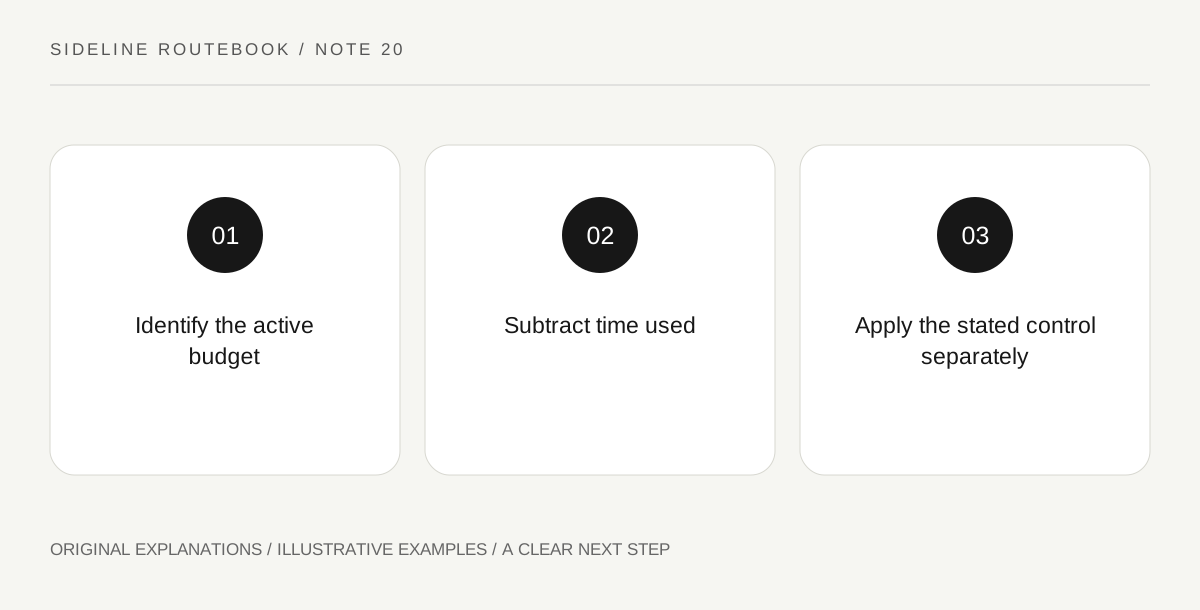
Original explanatory diagram. Read the full method and limitations below.
Attach each clock to a player
Draw two boxes labeled White time and Black time, with one active marker. FIDE’s clock rules describe a player stopping their clock and starting the opponent’s after making a move. The two budgets are separate, so the larger number is not a shared match countdown. Identify the names or colors used by the broadcast before interpreting a clock bar; visual placement can change when a diagram or camera layout is reversed.
Follow one simple move interval
For a paper exercise without increment, begin with White at 2:40 and Black at 3:10. Let White use twelve hypothetical seconds, producing 2:28, then switch the active marker to Black after the imagined move and clock press. Black’s budget has not been reduced by White’s twelve seconds. This intentionally simplified interval removes interruptions and special controls, making it easier to understand which player pays for the time passing during that part of the exercise.
Add the announced increment as a separate operation
Now choose an explicitly fictional practice control that adds five seconds after the move. Starting again from White’s 2:40 and subtracting twelve gives 2:28; adding five gives 2:33. Write the subtraction and addition on separate lines. The example explains why a displayed budget can rise after a move without implying that time ran backward. An actual event’s control must supply its own increment, delay or later-period conditions rather than inheriting this invented five-second assumption.
Keep clock reading separate from the result
A small number shows urgency but is not by itself a complete result report. Clock settings, the applicable rules, interruptions and the position can matter to a real ruling. Do not announce a loss solely because an edited broadcast briefly shows zero or a delayed overlay changes. Record the official result separately from your observation of the budget. The beginner skill is identifying whose time is running and which operation changes it, not adjudicating a time dispute from a spectator’s screen.
An original illustrative exercise
In an invented five-second-increment exercise, Black begins a turn with 1:20, uses nine seconds and then receives the stated five-second addition. The practice arithmetic is 80 − 9 + 5 = 76 seconds, or 1:16. White’s clock remains in its separate box until its turn becomes active. These fictional values demonstrate independent budgets and a stated increment, not a recommended control or a ruling on a real game.
Questions that come up
Why might a clock gain time after a move?
An announced increment can add time under the relevant control. Identify that control first; the five-second addition in this lesson is only an illustrative assumption, not a default for every chess event.
Can I add both clocks to find the exact remaining match duration?
No. The clocks are separate budgets and may involve additions, while the game can finish before either budget is exhausted. Their sum is not a promised wall-clock length for the viewing session.
References and scope
These sources support the factual background. Examples and exercises are original illustrative teaching material. References do not imply endorsement.
- FIDE — Laws of Chess effective 2023 — Standard result points and clock operation. The arithmetic and display examples are original.