Reconcile a basketball score change with one-, two- and three-point plays
When a basketball score jumps, a short arithmetic note can help you understand what the display is counting. Separate successful scoring actions from possessions and shot attempts. This exercise uses ordinary FIBA point values and invented sequences, with no prediction of who will score next or assessment of a player’s performance.
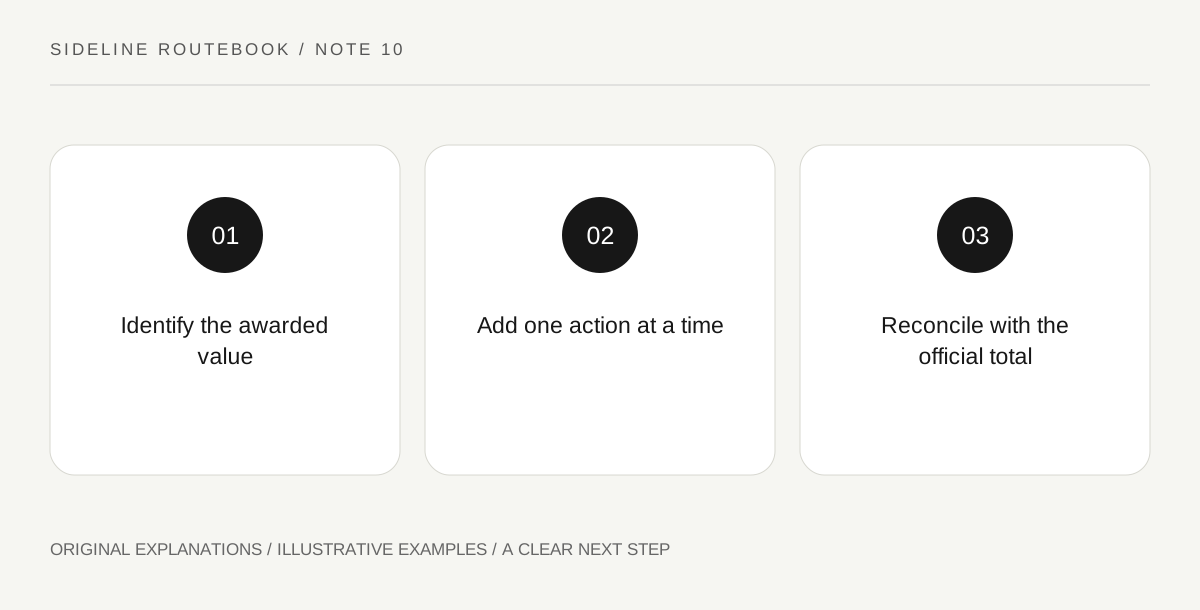
Original explanatory diagram. Read the full method and limitations below.
Put the point values beside the notebook
Under the FIBA 2026 rules, a successful free throw is worth one point, a goal from the two-point area two and a goal from the three-point area three. Keep those values visible as a small key. The rest of the exercise is original arithmetic using that key. It does not explain every circumstance in which a basket is valid or a shot is classified; the official decision supplies the awarded value for an actual play.
Record actions before adding a total
Create a row for each clearly awarded scoring action, writing team, value and resulting total. Do not add points for a shot merely because the crowd reacts or the camera follows the ball. A delayed display update can combine several actions visually, so a jump in the number is not always a single play. If you missed part of the sequence, mark the unexplained difference instead of inventing a scoring action that makes your arithmetic balance.
Distinguish equal totals from equal routes
Make two fictional ways to add six points: three two-point baskets, or a three-point basket plus a two-point basket plus one free throw. Both sums are six, but they describe different scoring histories. A total cannot uniquely reconstruct the actions that produced it. This matters when reading a short highlight clip: the score before and after the clip can reveal a difference without showing every attempt, possession or interruption that occurred between the two numbers.
Use corrections as a reason to revise the row
If an official score changes after a review or a correction, annotate the affected row rather than forcing the old total to remain true. Separate your running arithmetic from the official scoreboard, which remains the reference for the actual game. The notebook is a learning aid, so an unexplained discrepancy is a useful prompt to look for information. It is not proof that the operator or officials made a mistake, especially when the broadcast has omitted part of the sequence.
An original illustrative exercise
An invented team starts with 18 points, then receives an awarded two-point basket, one successful free throw and a three-point basket. The notebook reads 20, 21 and 24. A viewer who sees only 18 and 24 knows the difference is six but cannot identify that exact route from the total alone. The fictional rows demonstrate reconciliation without claiming a real scoring run or a particular possession count.
Questions that come up
Does a six-point increase mean two three-pointers?
It could, but other combinations also produce six. A change in the total does not uniquely identify the scoring actions, so use the visible sequence or official play-by-play for that question.
Does each row represent one possession?
No. This sheet records scoring actions, which are a different unit. A possession analysis needs additional context, so do not turn a list of awarded points into a possession count without it.
References and scope
These sources support the factual background. Examples and exercises are original illustrative teaching material. References do not imply endorsement.
- FIBA — Official Basketball Rules 2026 v1.1 — Effective 1 October 2026: point values, distinct foul counters, quarter lengths and the separate shot clock. Arithmetic exercises are invented.