Track netball centre passes without following the conceding team
A viewer arriving from another sport may expect the side that conceded to restart after every goal. Netball’s alternating centre-pass pattern needs a different notebook. Keep a pass-owner row alongside the score so that a run of goals by one team does not make you lose the next restart.
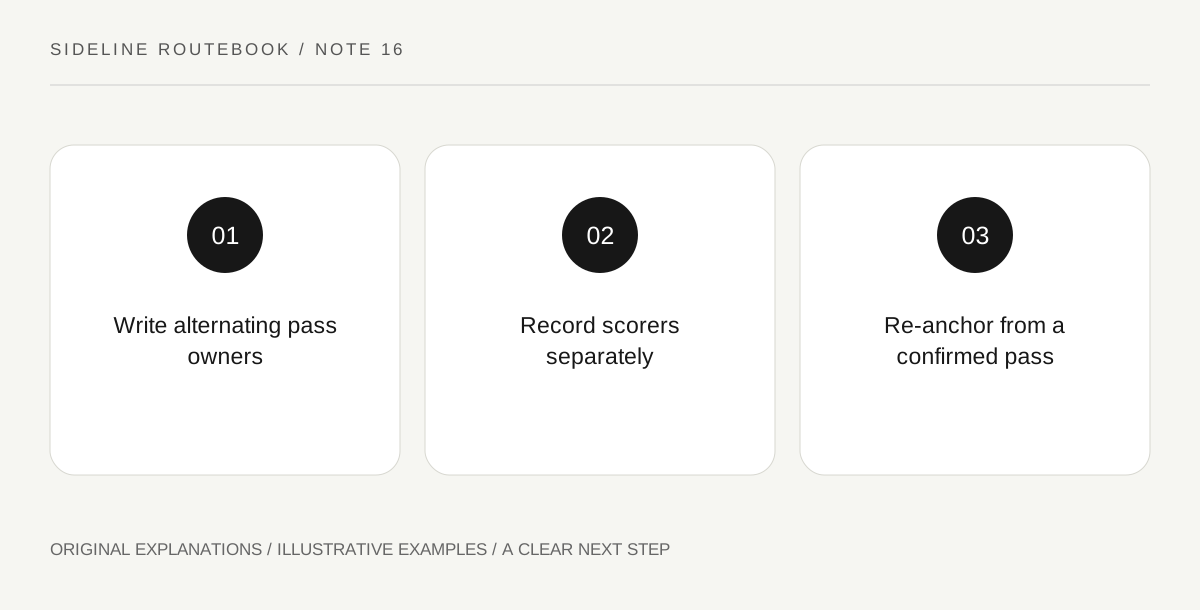
Original explanatory diagram. Read the full method and limitations below.
Create a pass sequence independent of scoring
World Netball’s centre-pass guidance explains the alternating allocation, rather than giving every next pass to the team that conceded. For a paper exercise, label the first centre pass A and write A, B, A, B across the page. The alternation is the narrow official fact used here. Keep the sequence separate from a row of goal scorers, because those names can repeat while the centre-pass owners continue to alternate.
Pair each passage with its starting owner
Draw a small bracket under each centre-pass slot and leave room for the resulting goal, if one follows. In this simplified exercise, each passage ends in a goal before the next centre pass. That deliberate assumption avoids interrupted or unusual sequences while teaching the basic reading pattern. If B scores after a passage started by A, write B in the goal row but do not change the next centre-pass slot you already assigned in the upper row.
Test the pattern with a scoring run
Now let A score three consecutive goals in your fictional sequence. The pass row can still read A, B, A for those three passages. This controlled example separates possession at the restart from the eventual scorer. Do not interpret the repeated A entries in the goal row as proof that the same side owned every restart. The two rows describe different events, and that distinction is exactly what the exercise is designed to make visible.
Recover from a missed passage carefully
If you miss part of a match, use the official centre-pass indication or the next clearly administered pass to re-establish the owner. Do not guess solely from who just scored. Leave an uncertain gap in your private sequence and begin a fresh confirmed segment. The purpose is to follow a match more comfortably, not to challenge officials with a spectator’s incomplete tally. A clean restart from a known observation is more useful than a long chain built on one unverified assumption.
An original illustrative exercise
In an invented practice sheet, the centre-pass owners are A, B, A, B, while the resulting goal scorers are A, A, A, B. A learner first tries assigning every pass to the side that conceded and quickly creates a different sequence. Comparing the two rows reveals the imported assumption. The fictional example demonstrates alternation without reproducing a match or claiming that every actual passage will end as neatly as this exercise.
Questions that come up
Does the last goal scorer identify the next pass owner?
Not on its own. Centre passes alternate, so the scorer row and pass-owner row can differ. Follow the pass sequence or the official indication rather than importing a conceding-team restart rule.
Should I repair every missing entry from memory?
No. Mark the missing passage and restart your private tally from a confirmed owner. An honest gap makes the rest of the record more useful than a guessed entry that reverses every later slot.
References and scope
These sources support the factual background. Examples and exercises are original illustrative teaching material. References do not imply endorsement.
- World Netball — Centre Pass Checks — Centre passes alternate rather than being awarded to the side that conceded.