Separate a player’s foul count from the team’s quarter count
Two foul counters on a basketball display can rise after the same incident while measuring different things. Put individual history and the current team-quarter total on separate lines. This introductory FIBA viewing exercise helps you follow the display without assuming that every whistle means free throws or that a team total belongs to one player.
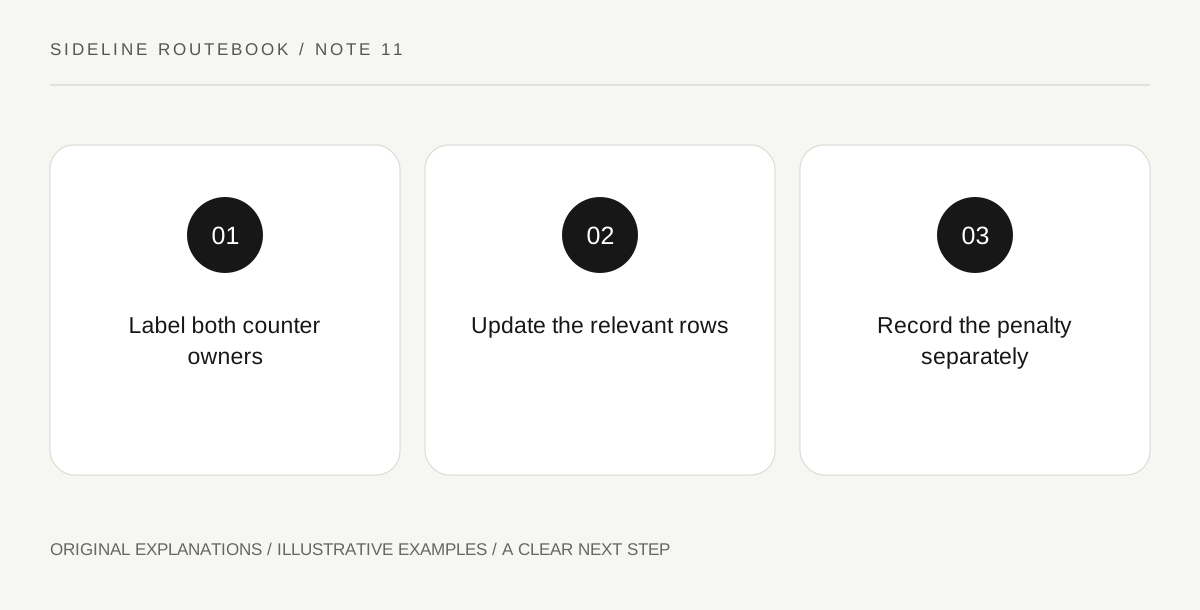
Original explanatory diagram. Read the full method and limitations below.
Name what each counter counts
Create a player line labeled with a shirt number and a second line labeled team, quarter. FIBA rules distinguish player fouls from the team-foul situation within a quarter. That is the narrow official distinction behind the exercise. Avoid writing one unlabeled number called fouls, because it cannot tell you whether you are recording one player’s history or a team’s current-period situation. A useful counter needs both an owner and a time frame.
Use a fictional ledger to see the difference
Imagine three teammates each receiving one ordinary personal foul in the same quarter. Their individual lines each read one, while the team-quarter line has accumulated three from those incidents. Now imagine one of those players receiving another personal foul. That player’s line and the team line change, but the other two individual lines do not. The arithmetic is simple; the learning comes from resisting the urge to copy a team total onto every player’s row.
Keep the penalty question separate
The FIBA rules contain a team-penalty situation and detailed consequences for different kinds of fouls. This small ledger does not reproduce those conditions. When free throws follow, record them as a separate awarded action rather than treating the whistle alone as a free-throw count. Shooting status, foul type and other conditions matter. If you are unsure, write penalty not yet confirmed until the officials administer or communicate it, instead of adding guessed points or attempts to the score.
Carry the correct information across a quarter boundary
At a new quarter, open a fresh team-quarter space while keeping your player-specific history distinguishable. Do not wipe your whole page simply because a broadcast’s team indicator changes. If a graphic disappears, that may reflect the display design rather than an incident being removed from the record. The ledger’s labels help you ask the precise question: is this a new period’s team situation, a player update or an official correction? Each belongs in a different place.
An original illustrative exercise
In an invented quarter, players 4, 9 and 12 each receive one personal foul, then player 9 receives another. The practice ledger shows individual entries 1, 2 and 1, with four incidents on the team-quarter line. It does not show that all three players have four fouls, and it does not infer a free-throw award from the total alone. The numbers illustrate counter ownership rather than an actual game.
Questions that come up
Can I tell the penalty from a single foul number?
Not reliably. The type and circumstances of the foul and the applicable rules matter. Use the official administration or explanation for the penalty instead of treating an isolated counter as a complete decision.
Does a new quarter erase a player’s foul history?
No. A team-quarter counter and an individual player’s history are different records. The exercise keeps them separate so that refreshing one period’s display is not mistaken for deleting the other information.
References and scope
These sources support the factual background. Examples and exercises are original illustrative teaching material. References do not imply endorsement.
- FIBA — Official Basketball Rules 2026 v1.1 — Effective 1 October 2026: point values, distinct foul counters, quarter lengths and the separate shot clock. Arithmetic exercises are invented.