Separate a substitution announcement from completed entry
A substitution board tells viewers that a change is being organized. It does not by itself show every stage of the procedure. Make a three-stage observation strip for announcement, departure and entry, then use it to follow one change without confusing a television caption with the player’s actual arrival.
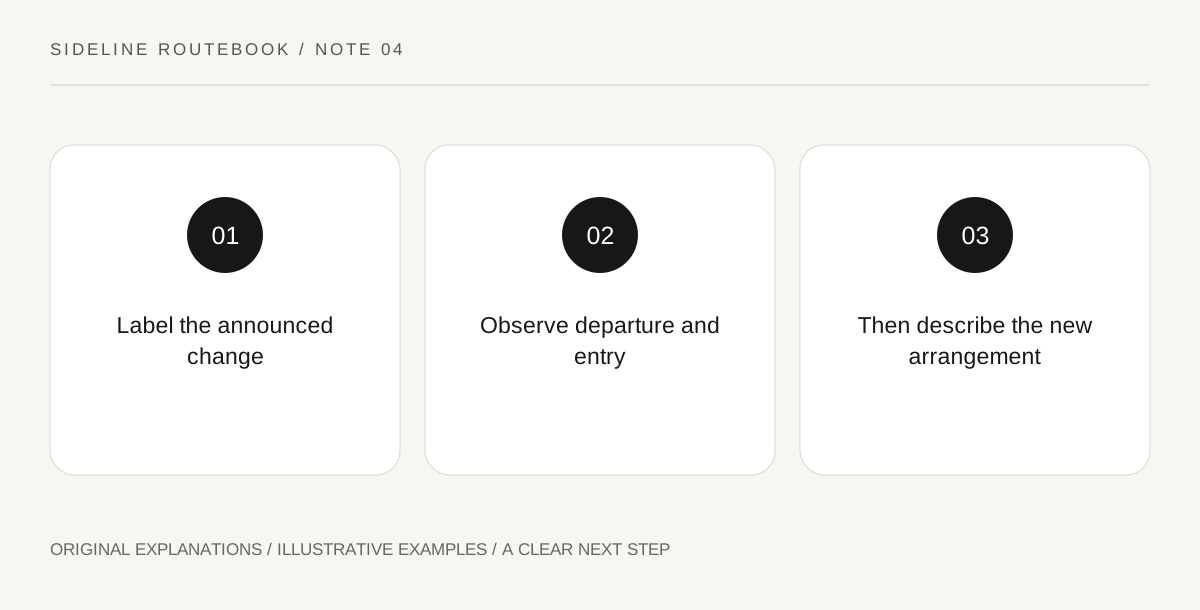
Original explanatory diagram. Read the full method and limitations below.
Identify the outgoing and incoming players
Write the two shirt numbers in separate spaces and add the team name. Do not rely on the direction of an animation if the broadcast does not explain it. The player warming up nearby may not be the one entering now. A simple pair of labeled names prevents a later tactical discussion from being built on the wrong substitution. If the camera cuts away, keep the missing part of the strip blank rather than assuming both players completed the change together.
Watch for the entry stage
Under IFAB Law 3, a substitution is completed when the substitute enters the field. The procedure also involves the departing player and the referee’s signal; a displayed board is not a substitute for those steps. On your observation strip, mark entry only when it is shown or clearly confirmed. The exercise is about the difference between a requested change and a completed one, not about timing compliance with a stopwatch from a broadcast feed.
Keep allowances outside the strip
The number of permitted substitutes, opportunities and special protocols depends on the applicable competition rules. Do not write a universal allowance at the top of every football note. If you want to track how many opportunities remain, first obtain that event’s rules and make a separate count. Multiple changes during one stoppage can otherwise make a plain player-in/player-out list look like an opportunity counter when it is actually recording a different unit.
Describe the tactical change after confirmation
Once entry is established, note one observable adjustment: a player occupies a wider area, another drops deeper or the camera has not yet shown the new arrangement. Avoid assigning a formation solely from the substitute’s usual position. A completed personnel change and a tactical interpretation are different pieces of information. Leave enough space to revise the latter after play resumes. That makes the strip useful for following the match rather than producing an instant, overly certain tactical verdict.
An original illustrative exercise
In a fictional broadcast, a board announces number 22 for number 7, then the camera shows the coach. The viewer records announcement seen and departure not shown. A later wide shot confirms number 22 on the field, so the entry space receives a note with the visible match time. The strip does not invent the exact entry second or treat the earlier caption as proof that the procedure had already finished.
Questions that come up
Can several players change in one stoppage?
Yes, but a list of personnel changes and a count of substitution opportunities serve different purposes. Read the competition’s allowances before combining them into one total or predicting what changes remain available.
Should I time the departure from the broadcast?
This basic viewing card does not assess timing compliance. Broadcast cuts and delay can hide important moments. Record what is visible and consult the current protocol if that detailed procedural question interests you.
References and scope
These sources support the factual background. Examples and exercises are original illustrative teaching material. References do not imply endorsement.
- IFAB — Law 3, players — The entry of a substitute completes the substitution; event-specific allowances and protocols need separate reading.