Read a chess result as a result, not a captured-piece score
A chess result line uses small numbers that do not count captured pieces. Separate the game result from tournament points and from any informal material evaluation. An invented three-round ledger shows how a player can accumulate standings points without adding the value of the pieces removed from the board.
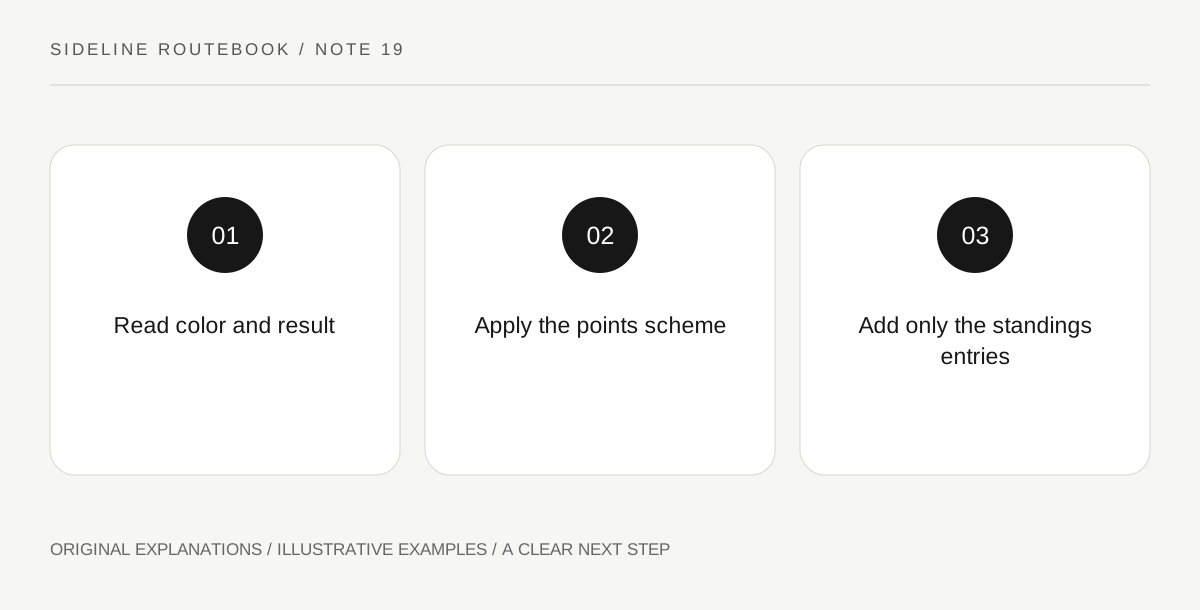
Original explanatory diagram. Read the full method and limitations below.
Label the result from White’s perspective first
Common recorded results include 1–0 for White’s win, 0–1 for Black’s win and ½–½ for a draw. FIDE’s normal points rule awards one for a win, half for a draw and zero for a loss unless event regulations specify otherwise. Keep the color columns visible when translating a result into one named player’s entry. A player alternating colors can win a game recorded 1–0 in one round and 0–1 in another.
Build a player-specific round ledger
Make columns for round, player color, recorded result and this player’s points. Fill the result before assigning the points. In a fictional first round, your player is Black and the result is 0–1, so the player receives one under the stated normal scheme. This extra color column may feel unnecessary at first, but it prevents the left-hand result number from being copied mechanically into every player’s total, regardless of which side that player used.
Keep material notes outside the standings sum
A commentator may discuss an advantage in pieces or use informal material values to explain a position. Those observations do not get added to the tournament score. Draw a separate position-notes box if you want to record them. The game’s final result supplies the normal standings entry, not the number of captures you counted. This distinction is useful for new viewers because a board can look materially uneven long before the recorded outcome is established.
Check the scoring scheme before comparing a table
Add the points for your fictional rounds only after writing the event’s scoring scheme above the ledger. If a tournament uses a different announced allocation, the same results need that scheme’s arithmetic. Equal totals can also require event-specific tie-break procedures, which this basic sum does not decide. Your ledger should therefore say total under this scheme rather than winner of the tournament. Accurate addition is only one part of understanding a complete standings table.
An original illustrative exercise
An invented player is Black in round one with result 0–1, White in round two with ½–½ and White in round three with 0–1. Under the normal one, half, zero scheme, the player earns 1 + 0.5 + 0 = 1.5 points. No captured-piece count enters the sum. The fictional ledger demonstrates color-aware result reading and does not supply a ranking or a tie-break verdict.
Questions that come up
Does 1–0 mean one piece was captured?
No. It is a recorded game result, with the first side referring to White in the usual notation. Material on the board is a different subject and does not become a captured-piece score in that result line.
Do equal point totals prove an equal final placing?
Not necessarily. Event regulations may specify tie-breaks or shared placings. The arithmetic ledger explains points earned under a stated scheme; it does not replace the tournament’s ranking rules.
References and scope
These sources support the factual background. Examples and exercises are original illustrative teaching material. References do not imply endorsement.
- FIDE — Laws of Chess effective 2023 — Standard result points and clock operation. The arithmetic and display examples are original.