Read a second-yellow sending-off as a timeline
A red card shown after a yellow can describe a different disciplinary sequence from a direct red. A small player-specific timeline helps you follow which caution belongs to whom and when. The aim is to read the displayed sequence accurately before forming an opinion about the underlying incidents.
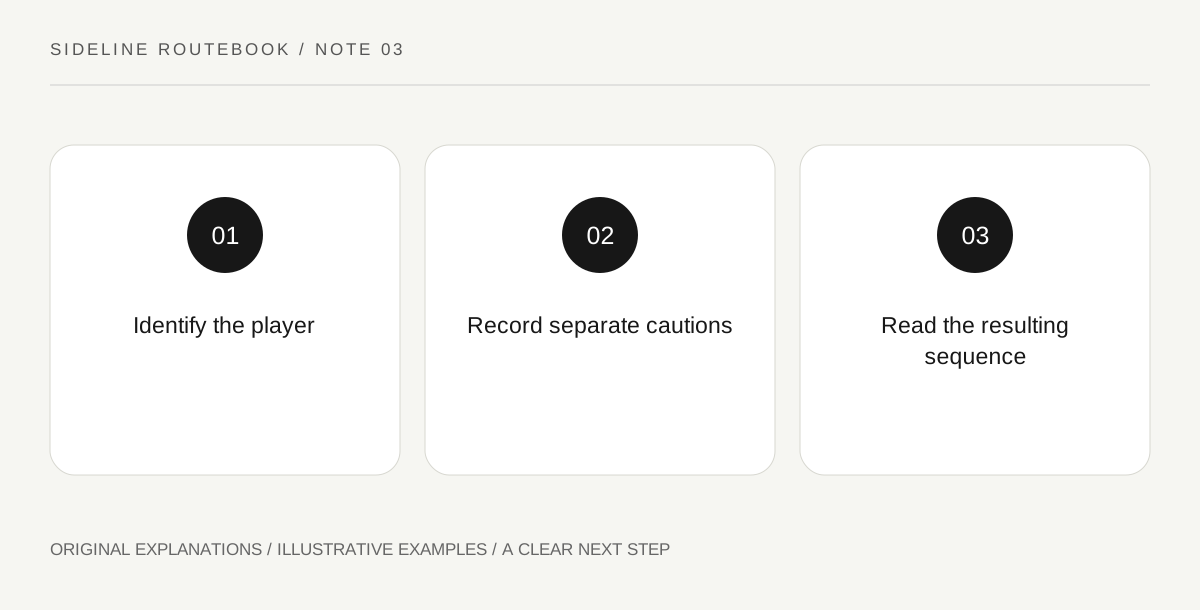
Original explanatory diagram. Read the full method and limitations below.
Start with a player identifier
Write the player’s team and shirt number at the left edge of your note. Underneath, leave room for separate incident entries. IFAB Law 12 includes receiving a second caution in the same match among sending-off offences. That fact makes a player-specific record useful: a team may have several yellow cards without any one player having two. A team-level total cannot answer the question that a second-caution graphic raises.
Give every incident its own row
For each observed caution, note the approximate match time and a neutral description, such as delayed restart or challenge near midfield. The descriptions are your viewing notes, not official disciplinary findings. Keep another player’s card on another line, even if the broadcast discusses both together. If you joined the match late, mark the first part of the timeline incomplete. A blank early section should not silently turn into a claim that no earlier caution occurred.
Read the sequence rather than counting colors
When a yellow and then a red appear, ask whether the yellow was this player’s second caution. A direct red may have a different recorded basis; do not infer the precise offence from the color alone. In your note, distinguish what you saw displayed from what the official match report later records. If the camera shows only a red, the earlier sequence may simply be outside the frame, so your description should leave that uncertainty visible.
Keep discussion of consequences on another page
Do not attach a guessed suspension length to your timeline. Competition disciplinary regulations and the recorded offence affect what happens afterward. The viewing exercise ends with identifying the on-field sequence, not predicting a future ban. If you later read the official report, add its description and date beside the relevant row. This keeps your immediate observations and the formal record connected without presenting your rough incident labels as an authoritative disciplinary summary.
An original illustrative exercise
Imagine a fictional match in which number 14 is cautioned at 27 minutes, number 8 at 46 and number 14 again at 68. A team graphic shows three cautions overall. The personal timeline shows why number 14 has reached a second caution while number 8 has not. The invented sequence illustrates the distinction between individual history and team totals; it makes no claim about a real player or suspension.
Questions that come up
Does a team’s second yellow mean somebody is sent off?
No. Two different players could each have one caution. This exercise follows the same player’s caution history within the match rather than treating all team cautions as one running personal total.
Can the television graphic be my only record?
It can help you follow the broadcast, but graphics may update late or omit earlier context. Mark incomplete information and use the official match record when the precise disciplinary description matters.
References and scope
These sources support the factual background. Examples and exercises are original illustrative teaching material. References do not imply endorsement.
- IFAB — Law 12, fouls and misconduct — A second caution in the same match leads to a sending-off; the incident timelines here are invented.